
Domestic
BALOCHISTAN
- Police Constable Ali Gohar was gunned down by unknown armed men in Dera Murad Jamali (15.1.26).
- A female teacher was shot dead by unidentified assailants in Sibi district (15.1.26).
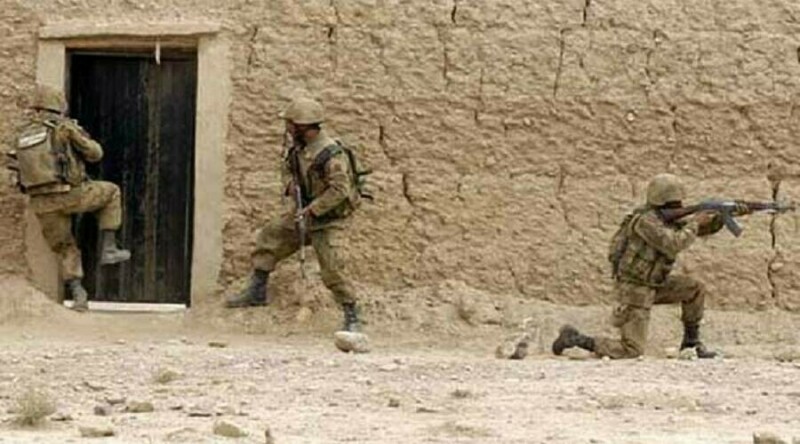
- Security forces killed 12 terrorists, thwarting their attack on a City Police Station, National Bank, and Habib Bank in Kharan district, where they had looted Rs3.4 million (16.1.26).
- Two people were killed in a landmine explosion while planting a mine in the Lanjo Safari area of Sui tehsil, Dera Bugti district (18.1.26).
- Unidentified armed motorcyclists carried out a hand-grenade attack near Aftab Chowk in the Sakran area of Hub district; no casualties were reported (18.1.26).
- CTD police claimed to have foiled a terror plot by killing five suspected terrorists in the Dasht area of Mastung district (19.1.26).
- Unknown saboteurs blew up the main railway track near Dera Murad Jamali, temporarily suspending the Quetta train link with the rest of the country (19.1.26).
- A massive fire at Haleem Plaza on Price Road, Quetta, destroyed at least 120 shops (21.1.26).
- Security forces killed three terrorists, including their commander Farooq alias Shoro, during an IBO in Panjgur district (25.1.26).
- Four bogies of the Quetta-bound Jaffar Express from Peshawar were derailed by a terrorist blast on the railway track between Sultankot and Jacobabad (26.1.26).
- Three armed dacoits looted Rs9.4 million from a bank, injuring a guard in Quetta, while police arrested eight suspected robbers in Nasirabad and Kachhi districts (26.1.26).
- CTD police claimed to have killed five suspects, including a wanted terrorist, and recovered arms, ammunition, and explosives from their possession during an IBO in Pishin district (27.1.26).
- Security forces killed eleven terrorists during an IBO on 29 January in Panjgur district and recovered weapons, ammunition, and robbery money looted from a bank on 25 December from their possession (30.1.26).
- Security forces killed 30 terrorists during an IBO on 29 January in Harnai district (30.1.26).
- At least 67 terrorists were killed and 10 security personnel were martyred as coordinated attacks struck multiple locations across Balochistan. The two-day death toll of terrorists rose to 70. The attacks hit 12 cities, including Quetta, Gwadar, Mastung, Noshki, Dalbandin, Kalat, Pasni, and Tump. Officials said the assaults were carried out by outlawed terrorist groups. The attacks followed security forces’ operations in Panjgur and Shaban a day earlier, where 41 terrorists had been killed (31.1.26).
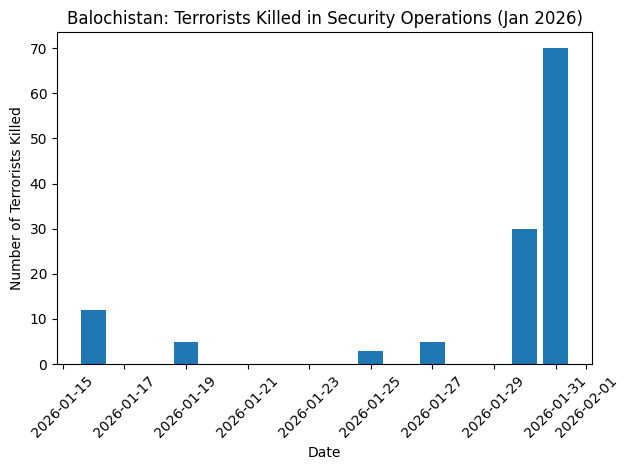
Comments & Analysis: The incident pattern reflects a high-intensity security environment marked by both persistent militant violence and strong kinetic responses by security forces. Targeted killings of police personnel and civilians (including a female teacher) indicate continued efforts by militants to intimidate state functionaries and society. Sabotage of critical infrastructure—particularly repeated attacks on railway lines and a major passenger train—highlights an intent to disrupt mobility, economic activity, and state writ. Criminal activity, such as large-scale bank robberies, appears intertwined with militancy, suggesting overlap between terrorist networks and organized crime, often to finance operations.
At the same time, the period shows robust counter-terrorism operations, with large numbers of militants killed in intelligence-based operations across Panjgur, Harnai, Mastung, Pishin, and Kharan. The coordinated attacks across 12 cities at month’s end point to improved militant coordination and reach, but the heavy militant casualties also indicate effective intelligence penetration and operational capacity of security forces. Overall, the situation suggests an escalatory phase: militants are attempting high-impact, multi-location attacks, while the state is responding with sustained, aggressive operations to degrade their networks and reassert control.
Socia media remains the contested battle field where the terrorists/insurgents try to unleash malicious propaganda. Along with BLA, Afghan and Indian accounts are quite active on this front. People and government of Pakistan are responding befittingly.
GILGIT-BALTISTAN (GB)
- Caretaker GB Information Minister Ghulam Abbas, speaking at the National Press Club in Islamabad, rejected Indian propaganda, stating that the people of Gilgit-Baltistan have always been loyal to Pakistan. He highlighted that GB joined Pakistan voluntarily without major violence, dismissing claims by Indian Prime Minister Narendra Modi of protests by GB residents seeking to join India. On this occasion, the GB Chief Minister’s spokesperson, Shabbir Mir, added that there is a strong local movement for Gilgit-Baltistan to become Pakistan’s fifth province (22.1.26).
ISLAMABAD
- Islamabad Police reportedly sought the services of two Army majors and 16 SSG commandos to train personnel of the newly formed Special Weapons and Tactics (SWAT) force (22.1.26).
KHYBER PAKHTUNKHWA (KP)
- A rocket hit an under-construction house in Defence Colony, Bannu, with no casualties reported. Separately, police foiled a terrorist attack on the Fatehkhel police check-post in the district (16.1.26).
- Police Constable Shehzad Umar was injured by unidentified assailants in Sadiqabad Bazaar, while police thwarted a sabotage attempt by recovering an explosive device planted in Khar Bazaar, Bajaur district (16.1.26).
- Four terrorists—Tayyab, Salman alias Sudais/Asad, Saqi alias Shafeeq, and Deewana—were reportedly killed in a clash between TTP and JaH in Akkakhel, Tirah Valley, Khyber district. The fight erupted over disagreements regarding the distribution of money earned from illegal drugs (17.1.26).
- Armed motorcyclists martyred Police Constable Iqbal in a targeted attack near Akhundan Mammakhel village, Bannu district (18.1.26).
- Police and CTD, in a joint operation, killed one terrorist and injured two others in Kulachi tehsil, Dera Ismail Khan district (18.1.26).
- Police and CTD, supported by local peace committee volunteers, destroyed militant hideouts in Dadiwala during an operation in the trans-river belt of Lakki Marwat district (19.1.26).
- Unknown assailants threw a grenade at KPK Housing Minister Dr. Amjad Ali’s residence in Swat; no casualties were reported (21.1.26).
- Eight people, including three children, were injured when a drone dropped explosives on a residential area of Mirali subdivision, North Waziristan district (21.1.26).
- Unknown armed men torched the Wana Welfare Association petrol pump on Dera–Tank Road, Dera Ismail Khan district, causing major damage but no casualties (22.1.26).
- Police Constable Sadam Hussain was martyred during an exchange of fire with terrorists in Metaki Beizankhel Taziri, Bannu district. In separate incidents, two boys were injured in Domel, Bodeenkhel, when a toy-like object exploded, while abducted driver Arif of the PHC Bannu Bench was safely recovered (22.1.26).
- Seven people, including Abdul Waheed Jigri and advocate Abdul Majeed Leghari, were killed and several others injured in a suicide attack during a wedding ceremony at the house of Peace Committee member Noor Alam Mehsud near Qureshi Mor, Dera Ismail Khan district (24.1.26).
- Police repelled a terrorist attack on the Serai Gambila police station in Lakki Marwat district (25.1.26).
- Two terrorists were killed by police in an encounter in the Domel area of Bannu district (26.1.26).
- Unidentified terrorists partially damaged Khaisur Bridge in Miryan tehsil, Bannu district (26.1.26).
- Security forces reportedly killed banned TTP commanders Ghafoor alias Ijaz and Arshad alias Zulfiqar during an exchange of fire in the Bakakhel area of Bannu district (26–27.1.26).
- Police foiled a kidnapping attempt in Bannu, rescuing jeweller Yasir Khan and arresting suspects Majid Nawaz and Mohammad Afaq after an exchange of fire near Lagray Kila village (27.1.26).
- Police claimed to have seized 12 kilograms of opium from a vehicle and arrested two suspects in Bajaur district (27.1.26).
- Police SHO Jammel Khan, critically injured in a gunfight with outlaws, later embraced martyrdom in Tajori town, Lakki Marwat district (27.1.26).
- Police repulsed a terrorist attack on the Shahtora police post in the Serai Naurang area of Lakki Marwat district (27.1.26).
Bifurcation of Swat into Two Districts
- The KPK government officially split Swat district into two administrative units—Swat and Bar Swat—effective immediately. Bar Swat district, with headquarters in Matta, will include Matta, Bahrain, and Khwazakhela tehsils, while Swat district, headquartered in Gulkada, will comprise Babuzai, Kabal, Charbagh, and Barikot tehsils (27.1.26).
- Unidentified assailants shot dead Muhammad Nazir at the doorstep of his house in the Jaara area of Dera Ismail Khan (28.1.26).
- A man, Najeebullah, was killed when an IED exploded in War Mamund tehsil, Bajaur district (28.1.26).
- Two children were seriously injured in a landmine explosion in the remote mountainous area of Pat Nai on the outskirts of Wana tehsil, Lower South Waziristan district (28.1.26).
- Unknown armed men attacked an under-construction government post near Makin Bazaar, injuring two labourers and abducting four others in South Waziristan district (28.1.26).
- About a dozen armed men reportedly ransacked a house in Kotka Atlas, Serai Naurang, Lakki Marwat district. The attackers stole a submachine gun and Rs400,000, torched an adjacent grocery shop, and fled. No casualties were reported. The house belonged to four brothers serving in the army, police, and prison departments (29.1.26).
- Five terrorists, including commander Zewaran alias Al-Badri, were killed in a joint operation by police and security forces in Bannu’s Domel tehsil, while three civilians, including two women, also reportedly lost their lives (29.1.26).
- In three separate encounters, police claimed to have killed three notorious hired assassins wanted in several cases in Rustam and Par Hoti, while three others escaped in Mardan district (29.1.26).
- In separate incidents, police claimed to have destroyed three hideouts along the Kurram River in Naserkhel, Wanda Sher Dil, and Wanda Akhundan; killed dacoits Bahadur, Adnan, and Kalimullah near Dallokot Phattak on Lakki Road; and defused an IED planted under a bridge near Sarga Kherukhel Morr targeting police and security forces in Lakki Marwat district (30.1.26).
- A police vehicle transporting prisoners in Rangin Abad, Karak district, was reportedly fired upon, killing two prisoners and injuring a police officer (31.1.26).
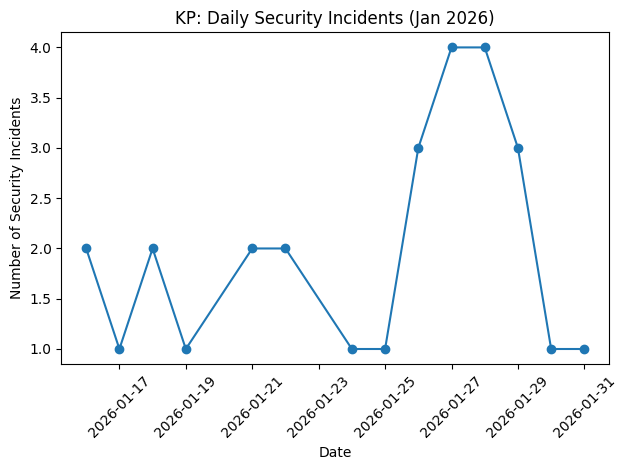
Comments & Analysis: The incident pattern in KP during the second half of January 2026 reflects a highly volatile, multi-dimensional security environment. Militancy remained concentrated in southern and merged districts—notably Bannu, Lakki Marwat, Dera Ismail Khan, North and South Waziristan, Bajaur, and Khyber—with a mix of terrorist attacks, targeted killings, drone strikes, IED incidents, and criminal violence. The use of quadcopter drones, attacks on police personnel, and strikes on peace committee members and civilian gatherings (notably the suicide bombing at a wedding in Dera Ismail Khan) indicate sustained terrorist intent to undermine local security architecture and community cooperation.
At the same time, the data shows persistent and increasingly assertive law-enforcement and security force responses. Multiple joint police–CTD–security force operations neutralised terrorists, including senior TTP commanders, disrupted militant hideouts, and dismantled criminal and narcotics networks. Internal militant frictions—such as the TTP–JaH clash over drug proceeds in Tirah Valley—underscore fragmentation within militant ranks, which security forces appear to be exploiting operationally. The administrative bifurcation of Swat into Swat and Bar Swat districts suggests a governance-driven attempt to improve control, service delivery, and security management in historically sensitive terrain.
PUNJAB
- CTD police claimed to have arrested 49 suspected terrorists, including Mujtaba from Lahore, allegedly linked to India’s RAW, and seized explosives and sensitive maps suggesting plans to target key installations in multiple cities (18.1.26).
Katcha Riverine Area Anti-Dacoit Operations (South Punjab & Sindh)
- Ten members of the Sikhani and Kosh gangs surrendered in Rahim Yar Khan during joint operations by Punjab and Sindh police and Rangers, while 29 more surrendered in Dera Ghazi Khan and 65, including Sadri Lund, in Rajanpur. Authorities destroyed 30 hideouts. Two alleged dacoits of the Indhar gang, Asghar Mallah and Sharif Gopang, were killed in a joint Punjab–Sindh operation (17, 24, 28.1.26).
- CTD police arrested Ghulam Yasin, a Sipah-e-Sahaba member, in Pakpattan for spreading hate material and collecting donations for the banned group (26.1.26).
- An alleged TTP-affiliated terrorist, Yasir Afridi, was arrested by CTD police during a raid on the Maryam Nawaz Health Clinic on Arifwala Road, Sahiwal district (28.1.26).
- CTD police killed six terrorists in an operation near Dam in Chapri, Mianwali; identities are being verified (30.1.26).
SINDH
- A huge fire at the Karachi International Container Terminal destroyed imported goods—mostly lithium batteries—in 20 containers. No injuries were reported as workers were at Friday prayers (16.1.26).
- Police arrested two suspects in a decades-long abuse case in Karachi, and in a separate case arrested six officers, including an ASI, for allegedly raping a girl in custody in Jacobabad (16, 19.1.26).
- Police claimed to have killed six suspected Afghan armed dacoits—Naqeebullah, Abdul Bari, Allah Dad, and Mujeebullah—wanted in dozens of robbery and criminal cases during an encounter in the Pak Colony area of Karachi (23.1.26).
- A gun battle between police and eight highwaymen left SHO Kemiso Khan martyred in the Lahi Ghulam Shah area of Shikarpur district (23.1.26).
- A blaze on 22 January collapsed the ground-plus-three-storey Gul Plaza building in Karachi, housing 1,200 shops over 8,000 square yards, killing 71 people and injuring many others. Police filed an FIR against unknown persons, citing negligence and lack of safety measures. The incident highlights the widespread presence of unsafe, unapproved structures in Karachi and across Pakistan (25.1.26).
- Unknown assailants shot and killed local PPP activist Abdul Rasheed at a clinic in Pak Colony, Karachi (31.1.26).
DEFENCE AND SECURITY
- Pakistani and US troops concluded joint military exercise Gambit-2026, held from 8–16 January at the National Counter-Terrorism Center, Pabbi, to strengthen cooperation, refine counter-terrorism drills, and enhance interoperability (16.1.26).
- The Pakistan Air Force deployed F-16 Block-52 jets and crew to Saudi Arabia for the multinational Exercise Spears of Victory-2026 alongside forces from 11 countries, enhancing interoperability and operational readiness (19.1.26).
- Pakistan Navy ships Tabuk and Moawin conducted a swift MEDEVAC of a critically ill Sri Lankan crew member from Indonesian-flagged MV Grey Palm 800 nautical miles off Pakistan’s coast, earning appreciation from Sri Lankan authorities (25.1.26).
- Pakistan Navy assumed command of Combined Task Force-150 for the 14th time in Bahrain, with Commodore Muhammad Yasir Tahir taking over command (29.1.26).
- COAS & CDF Field Marshal Syed Asim Munir, accompanied by the Interior Minister, visited the National Police Academy, Islamabad, interacted with senior officers, paid tribute to fallen police personnel, emphasized people-centric policing, and assured full Armed Forces support (20.1.26).
- The COAS & CDF visited Bahawalpur Garrison, reviewed operational preparedness, witnessed Exercise Steadfast Resolve, inaugurated the ROHI eSkills Learning Hub and APS Abbasia Campus, and visited the EME Regional Workshop (29.1.26).
- General Selcuk Bayraktaroglu, Chief of the Turkish General Staff, called on the COAS & CDF at GHQ to discuss regional security and strengthen Pakistan–Türkiye defence cooperation (30.1.26).
DIPLOMATIC DEVELOPMENT AND SIGNIFICANT EVENTS
- The Indian Coast Guard arrested nine Pakistani fishermen and seized their boat Al Madina, marking the second such incident within a month. The detained fishermen, identified by the Pakistan Fisherfolk Forum, include Mohammed Idris, Mohammed Yousuf, Fareed Aslam, Mohammed Hussain, Ibrahim Sona Mian, Mohammed Shahid, Mohammed Younis, Mohammed Haroon, and Arif Hassan (16.1.26).
- President Asif Ali Zardari, accompanied by a high-level delegation, met UAE President Sheikh Mohammed bin Zayed Al Nahyan and Vice President and Prime Minister Sheikh Mohammed bin Rashid Al Maktoum during his four-day visit to Dubai. Both sides discussed strengthening bilateral relations, with a focus on economic, trade, and investment cooperation (27–28.1.26).
- Pakistan enforced strict health screening and mandatory clearance at all entry points, with 100% passenger screening and enhanced surveillance, after Nipah virus cases were confirmed in India’s West Bengal. Nipah is a rare and often deadly virus transmitted mainly from fruit bats to humans, causing severe fever and neurological and respiratory complications. It has a fatality rate of 40–75%, limited human-to-human transmission, and no approved vaccine or treatment (28.1.26).
- Prime Minister Shehbaz Sharif, in a meeting with EU Ambassador Raimundas Karoblis in Islamabad, reaffirmed Pakistan’s commitment to deepening trade and cooperation with the European Union. He highlighted the role of the GSP+ scheme in boosting Pakistan–EU trade through the Strategic Dialogue. Granted in 2014 and extended until 2027, GSP+ provides duty-free access to most EU tariffs, significantly increasing Pakistani exports, particularly textiles. Exporters and analysts noted that the meeting was timely, as the EU–India Free Trade Agreement concluded on 26–27 January could boost India’s exports and undermine Pakistan’s competitiveness in European markets (29.1.26).
- Addressing major exporters and business leaders at a ceremony in Islamabad, the Prime Minister announced a Rs4.4 per unit reduction in electricity tariffs for the industrial sector to boost productivity and exports, stating he would have reduced it further if possible. He noted that he and CDF Field Marshal Asim Munir had visited several countries to secure financial support for the IMF programme and praised China, Saudi Arabia, the UAE, and Qatar for their critical assistance. He also emphasized government support for small and medium enterprises (30.1.26).
REGIONAL
AFGHANISTAN
Law and Order / Security
A blast at a Chinese–Afghan restaurant in Kabul killed seven people, including a Chinese national identified as Ayub. ISIS-K reportedly claimed responsibility, citing retaliation for China’s treatment of Uyghurs, prompting China to warn its citizens against travel to Afghanistan. Tajikistan reported that its forces killed four suspected militants who crossed illegally from Afghanistan’s Badakhshan province. In a separate incident, Tajik border guards clashed with five armed drug smugglers near the Afghan border, killing three, according to Khovar News Agency. Taliban-led IEA authorities seized 286 military cameras near the Iran border in Nimruz province, arrested two suspects, and defused a 500-kg unexploded bomb in Herat, urging the public to report suspicious ordnance (18, 19, 20, 30.1.26).
Diplomatic Developments and Ties with Foreign Countries
Ariana Afghan Airlines increased air cargo capacity to 16.5 metric tonnes per flight by operating a chartered Boeing 737-300 freighter on the Kabul–Delhi route. UK envoy Richard Lindsay met Taliban representative Sardar Ahmed Shakeeb in Islamabad to discuss regional security and women’s policies, without recognizing the Taliban government. Afghan authorities announced a ban on medicine imports from Pakistan after 9 February, raising concerns about shortages and price hikes in Afghanistan. IEA spokesperson Zabihullah Mujahid told The New York Times that Afghanistan seeks the release of the last Afghan detainee at Guantánamo Bay in exchange for American detainees, though talks have stalled over Muhammad Rahim. Russian and Afghan defence officials met in Moscow to discuss expanded cooperation and agreed on more regular collaboration, although no official Taliban statement was issued (18, 21, 27, 29.1.26).
Comments & Analysis:Prospects for Pakistan–Afghanistan normalization remain low due to the Taliban’s continued refusal to act against TTP, Baloch separatist, and other terrorist groups operating from Afghan territory. Acting Foreign Minister Amir Khan Muttaqi warned that false statements, internal disputes, and unfulfilled promises harm governance and stressed the need for individual-level reform. IEA spokesperson Zabihullah Mujahid stated that Taliban laws fully align with Sharia, reject foreign criticism, and criminalize objections. Analysts note persistent internal divisions within the Taliban, suggesting that only limited policy shifts may occur to improve Afghanistan’s international image.
According to the former Special Envoy of Pakistan to Afghanistan, Asif Durrani, economic situation in Afghanistan is going from bad to worse. Taliban’s flawed and myopic policies general public is suffering badly. Starvation and hunger are on the rise.
BANGLADESH
- The Bangladesh Army reportedly plans to raise three new special forces units, including a brigade, increase manpower, and reduce reliance on training in India. These proposals were discussed at a two-day generals’ conference held at Dhaka Cantonment on 25–26 January (26.1.26).
Bangladesh 12 February Elections
- General elections in Bangladesh are scheduled for 12 February 2026 under caretaker leader Muhammad Yunus, with over 127 million registered voters and a constitutional referendum on major reforms. The vote will take place amid tight security and political tensions, with the BNP, Jamaat-e-Islami, smaller parties, and new movements competing for power, alongside the growing influence of youth voters. Exiled Awami League leader Sheikh Hasina, barred from participation and sentenced to death in absentia, condemned the elections, warning that “a government born of exclusion cannot unite a divided nation.” The outcome remains uncertain, with the new leadership facing challenges of restoring trust, accountability, and democratic stability. Global powers are closely watching the results due to their implications for Bangladesh’s regional ties with China, India, Pakistan, and Western countries, as well as its strategic position in the Bay of Bengal and the Indian Ocean (30.1.26).
- After a 14-year suspension, direct flights between Pakistan and Bangladesh resumed when Biman Bangladesh Airlines’ inaugural flight from Dhaka landed at Karachi Airport on 29 January. Following the ouster of the Awami League government led by exiled former Prime Minister Sheikh Hasina, Pakistan and Bangladesh have moved closer diplomatically (30.1.26).
Myanmar Elections
- Myanmar’s military-backed USDP won a sweeping victory in recent elections, securing majorities in both legislative chambers. The polls were held amid civil war and repression, with minorities such as the Rohingya largely excluded. ASEAN, under the Philippines’ chairmanship, and human rights groups rejected the results, citing violence, fear, and lack of inclusivity (30.1.26).
CHINA
- British Prime Minister Keir Starmer met Chinese President Xi Jinping on 29 January to strengthen a long-term China–UK strategic partnership, resuming high-level dialogues and signing 12 cooperation agreements. The visit emphasized economic, technological, and cultural cooperation through diplomacy, trade, and people-to-people engagement. Meanwhile, U.S. President Donald Trump warned the UK and Canada that closer ties with China are “dangerous,” reflecting Western recalibration toward Beijing amid unpredictable U.S. policies (31.1.26).
ILLEGALLY INDIAN-OCCUPIED JAMMU AND KASHMIR (IIOJK) / LoC
- A suspected IED was recovered and defused in Zainapora, Shopian district. Ten Indian Army soldiers were killed. An innocent Kashmiri youth, Usman, was martyred in a fake anti-militancy encounter by joint security forces and police in the Balawar area of Kathua district (21, 23.1.26).
- IIOJK Chief Minister Omar Abdullah, speaking in Srinagar, accused the BJP of initiating the bifurcation of Jammu and Kashmir, countering claims that he supports a united region including Ladakh. He was responding to BJP leader Tarun Chugh’s statement advocating a fully united Jammu and Kashmir, including Pakistan-controlled areas (25.1.26).
INDIA
Defence and Security
- Bharat Electronics Limited unveiled a ground-based UHF communication jammer at the International Electronic Warfare Conference in Bengaluru, highlighting its delivery to the Indian Air Force and its ability to intercept, monitor, jam, and locate hostile signals. Separately, ARDE is developing an indigenous 7.62-mm anti-drone bullet that fragments mid-air to counter small unmanned aerial systems using standard rifles (20.1.26).
- The High Altitude Warfare School conducted a two-week specialized course for a five-member U.S. Air Force team, focusing on high-altitude operations under extreme weather conditions, including military skiing, casualty evacuation, and avalanche rescue (21.1.26).
- Lieutenant General Manoj Kumar Katiyar, GOC-in-C Western Command, reviewed operational preparedness of logistics headquarters under the Jalandhar-based XI Corps (Vajra Corps). Separately, CDS General Anil Chauhan released the Military Quantum Mission Policy Framework to integrate quantum technologies across the tri-services (22.1.26).
- Indian Army Northern Commander Lt Gen Pratik Sharma chaired security review meetings in Srinagar and Nagrota, later visiting Kishtwar to assess the counter-terrorism grid. This was followed by GOC 16 Corps Lt Gen P.K. Mishra’s visits to Kathua and Udhampur to review operations and stress vigilance (22, 29, 31.1.26).
IRAN
- According to global media reports, widespread anti-government protests in Iran, which resulted in hundreds of civilian and security casualties, largely subsided by 16 January following a heavy crackdown. Security forces maintained a strong presence, arrests continued, and surveillance intensified despite sporadic unrest. Authorities blamed “terrorists and armed rioters” for violence, particularly in Kurdish regions. Separately, an explosion at an eight-storey building in Bandar Abbas killed at least one person and injured 14, destroying two floors and nearby vehicles and shops; the cause remains unknown (17, 19, 31.1.26).
- Iranian Foreign Minister Abbas warned the United States that any attack would be met with full force, citing strategic ties with China and Russia. While the EU considered sanctions, the UAE, Saudi Arabia, and Azerbaijan emphasized neutrality and refused to allow attacks via their airspace. Iran condemned the EU’s blacklisting of the IRGC as politically motivated and reaffirmed willingness to resume nuclear talks but rejected negotiations on its missile program. President Trump stated he hopes to avoid military action while keeping diplomacy open (21, 27, 29, 31.1.26).
Comments & Analysis: Pakistan, sharing deep ties and a long border with Iran, opposed any U.S. aggression. Prime Minister Shehbaz Sharif urged diplomacy during a call with Iranian President Masoud Pezeshkian, while Turkey also worked to avert conflict. Gulf monarchies fear retaliation on U.S. bases and regional instability, including potential disruption of the Strait of Hormuz. Unconfirmed reports suggest Iran, China, and Russia have entered a strategic understanding against Western dominance, indicating movement toward a multipolar order.
MIDDLE EAST
- The United States began reducing its ground presence in Iraq, handing over key bases, including Ain al-Asad Airbase, to Iraqi control, shifting toward intelligence-driven and precision-strike operations (19.1.26).