
Tariq Lodhi

The failed Jaffar Express hijack episode—engineered by cross-border Indian surrogates and HIAs, and executed by the BLA—continues to produce ripple effects, gradually unraveling a broader conspiracy. In our previous article,[1] we had already detailed two major follow-up events, Jandola and Nushki, both of which were thwarted by the prompt countermeasures of the Pakistan military. Nevertheless, further reverberations and chain reactions continue to emerge in the region, as hasty damage-control exercises are being orchestrated by the masterminds across our eastern border. These HIAs are scrambling to salvage the grand “Great Game” plan, which aimed to converge and escalate terrorism-driven schemes into a major head-on confrontation.
From the outset, it was evident that the perpetrators of the Jaffar Express hijack intended to stretch the incident over an extended period, leveraging 5GW tools of political disinformation and propaganda to gain global attention. Indian propaganda operatives remain engaged 24/7 in crafting narratives designed to provoke public sentiment against Pakistan’s security forces and undermine their ability to combat terrorist threats. India’s strategy is to push Pakistan into negotiations with non-state actors, thereby legitimizing terrorists as state actors and escalating this round of hybrid warfare. India’s flat-out 5GW attacks are a hedge against the failure of its proxy groups’ kinetic actions.
An unbiased analysis now confirms that the Jaffar Express incident was orchestrated within a broader regional canvas—stretching from Myanmar to Iran—interweaving the interests of multiple stakeholders allied with Indian intelligence. The objective was to culminate the episode in a mass casualty event involving innocent passengers, while sacrificing suicide bombers and other expendable BLA foot soldiers. This was intended to echo a “Pakistan’s 9/11” moment, though only after dragging the incident out for weeks or even months to extract its maximum propaganda value.
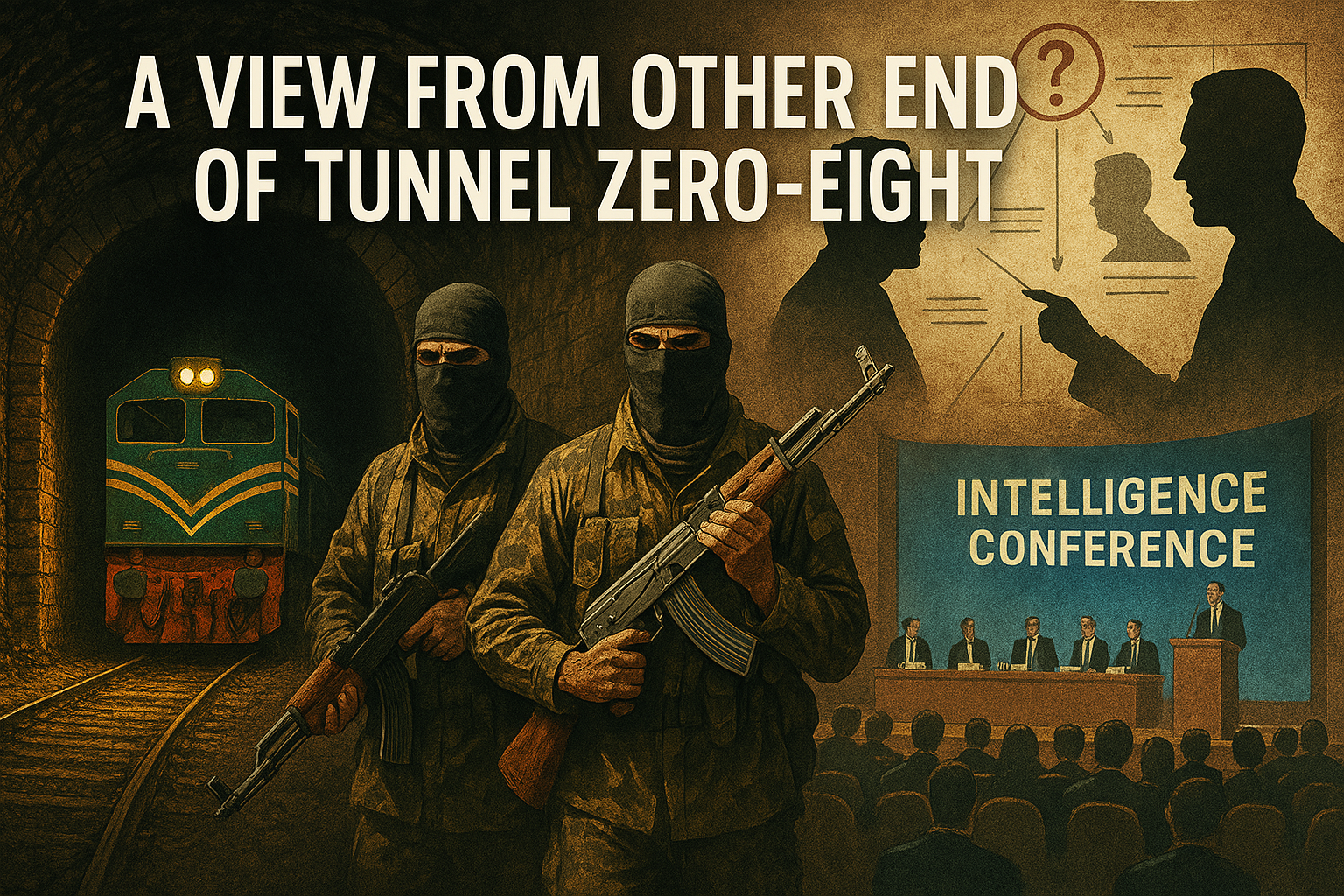
The HIAs intended to prolong the Jaffar Express episode so it would coincide with the 4th Security and Intelligence Chiefs’ Conference and the Raisina Dialogue, held from 16–18 March 2025 in New Delhi. Hosted by India’s National Security Council Secretariat (NSCS) and the Research and Analysis Wing (R&AW), this conference has been likened to India’s version of the Munich Security Conference or Singapore’s Shangri-La Dialogue.[2] While India claimed to have invited about 20 foreign intelligence chiefs, media reports indicated participation primarily from the Five Eyes alliance.[3] Most attendees were heads of various Indian security and intelligence organizations. Indian media reports (which appear exaggerated) claimed 28 participants, the majority being from Indian institutions.[4]
The agenda covered Counterterrorism, Indo-Pacific cooperation, global security, intelligence-sharing mechanisms, immigration, extradition, transnational crime, narcotics, and terror financing. Judging by its timing and agenda, it seems India sought to pivot this conference around the fallout from the Jaffar Express incident—amplified by its propaganda machinery—to build a regional bloc against Pakistan, Bangladesh, and China, akin to the 1976 Safari Club formed against Soviet influence. Predictably, India also sought to downplay Pakistan’s military role in combating global terrorism and portray Pakistan as a state willfully harboring groups it deems terrorists.
It is increasingly apparent that Indian HIAs attempted to synchronize the peak of the Jaffar Express and related terror events in Balochistan and Khyber Pakhtunkhwa with the 4th Security and Intelligence Chiefs Conference as a prelude to the Raisina Dialogue.[5] The Raisina Dialogue—hosted by the Indian Ministry of External Affairs and the Observer Research Foundation—featured the notable participation of U.S. Director of National Intelligence (DNI), Tulsi Gabbard, representing the newly instated Trump administration.
Her itinerary included visits to Japan and Thailand. Thailand had just drawn international media attention for deporting several Uyghurs to China, an act perceived as pro-Chinese and contrary to the Western narrative on Uyghur persecution.[6] Japan, a powerhouse in the QUAD and a major player in South Pacific geopolitics, is seen as a bulwark against rising Chinese influence.[7] While in India, Gabbard met with the Indian Prime Minister and Defence Minister on 17 March 2025. Symbolically, the Indian PM presented her with “Gangajal” from the Maha Kumbh Mela, and she reciprocated with Tulsi beads—gifts that, under diplomatic protocols, carry significant symbolic weight and indicate deepening ties.[8]
Tulsi Gabbard’s whirlwind Southeast Asia tour underscores the urgency with which India seeks to align its strategic objectives with those of the U.S. and simultaneously escalate its anti-Pakistan agenda through kinetic and 5GW means.
According to Indian media outlets, Gabbard emphasized U.S. commitment to global counterterrorism efforts, specifically Islamic terrorism. Some Indian media reports claimed that for the U.S., attacks originating from Pakistan were viewed no differently than those impacting other nations. However, mainstream newspapers were more cautious and avoided explicitly naming any third country. In contrast, second-tier outlets pushed a hostile narrative, likely designed to sow confusion about the conference outcomes. These media, representing Indian establishment views, also expressed concern over Bangladesh, which they believe is drifting closer to China in an attempt to insulate itself from U.S. pressure.
A report released on 25 March 2025 by the U.S. National Intelligence—under Gabbard’s leadership—curiously omitted Afghanistan, despite repeated warnings from the UN and UNSC that over two dozen international terror groups are operating from there. ISIS-K, for example, is directing attacks from Afghan soil across Iran, Pakistan, and into Central Asia.[9] Similarly, the TTP continues operations from Afghanistan with support from ex-ANDSF personnel and with impunity under the AIG. The omission of Afghanistan from the report is a strategic signal of future U.S. policy, hinting at India’s potential clandestine role against Pakistan.
Although TTP and its nexus with Al-Qaeda were mentioned, the report only acknowledged that they “could pose a future threat to the West,” downplaying current cross-border implications. This omission conveniently leaves Pakistan holding the burden. It’s likely the Jaffar Express hijack was meant to provide timely “hot content” for the NIA report, whose drafters could not have ignored such an incident if it were still ongoing. Indian HIAs may have anticipated the report’s contents and sought to influence its narrative.
India aimed to fabricate, manipulate, and disseminate doctored visuals and propaganda from the Jaffar Express site to support a toxic roadshow. It sought to shape global perception, especially regarding Balochistan and KP, in a way similar to Israel’s handling of Iran’s alleged nuclear archive in 2018. That operation—codenamed “House of Cards”—involved MOSSAD extracting 55,000 documents and 183 CDs from Iran, which were then flown via Azerbaijan to Tel Aviv. Israel used this material in global roadshows to justify its stance against Iran and catalyze U.S. withdrawal from the JCPOA.
Similarly, India wants to mimic these tactics to elevate its intelligence community to the stature of MOSSAD and rival the CIA. But its recent efforts have been thwarted by Pakistan, leaving India struggling to execute damage control, despite its flexible hybrid warfare playbook.
Israel’s deepening relations with Azerbaijan, including intelligence cooperation, are also contributing to perceptions that Azerbaijan is becoming a MOSSAD staging ground against Iran. This has sparked calls for Azerbaijan to be included in the Abraham Accords and for U.S. sanctions to be lifted. In parallel, India is aligning itself with these developments, contributing to the strategic pressure on both Iran and Pakistan.
As more details emerge about the 11 March 2025 Jaffar Express incident, forensic analysis suggests that an IED was detonated under the second bogie after the locomotive had passed. The precision indicates either remote detonation that was slightly mistimed or a miscalculation due to the train’s reduced speed. The derailment halted the train outside the tunnel, forcing terrorists to abandon their original plan. The sudden appearance of drones and rapid deployment of sharpshooters further disrupted the terrorists’ operations.
The intent was to split the passengers—hostages taken to safe havens while others were herded into the tunnel for a prolonged standoff—coinciding with other attacks in Pakistan and the intelligence conference in New Delhi.
The quick response by Pakistani security forces foiled the terrorists’ plan. Those leading from the rear recognized the failure and the risk of their operatives being captured alive. These individuals likely had direct ties to Afghan and Indian intelligence, much like Kulbhushan Jadhav. The plan to commit suicide was interrupted, leaving critical evidence intact: the bodies of the terrorists. The HIAs then moved rapidly to erase this evidence. It is speculated that Dr. Mahrang Baloch—manipulated by HIAs due to her emotional commitment to the issue of enforced disappearances—is being groomed as the political face of BLA. She was possibly lured to the morgue where accomplices, posing as sympathizers, snatched the bodies with the help of aligned medical staff.
[1] Please see “In Between The Lines of Hybrid Warfare” Strategic Brief of 19-Mar-2025, https://thestrategicbrief.com/2025/03/19/in-between-the-lines-of-hybrid-warfare/;
[2] “Amid global uncertainties, spy chiefs from across world converge in Delhi”, The Hindu, 16-Mar-2025, < https://www.thehindu.com/news/national/amid-global-uncertainties-global-spy-chiefs-converge-in-delhi/article69337785.ece>;
[3] Five Eyes is an intelligence alliance of five countries, which has developed from World War-II times under the UK-USA’s secret agreement, and includes USA, UK, Canada, Australia, and New Zealand. It is mainly focused on SIGINT, for surveillance, Cyber-Security, Counter-Terrorism, Economic-Intelligence, Diplomatic, Defence and Economic Intelligence, Data-Collection, and any other intelligence-faculty it agrees to be added to its agenda. There are reports of more states such as Denmark, France, Netherlands and Norway, joining this alliance, modifying its name to Nine Eyes, and addition of another five states, including Belgium, Germany, Italy, Spain and Sweden, elevating its name to Fourteen Eyes.
.
[4] Significant heads of intelligence organisations included Mr. Jonathan Powell the UK’s National Security Adviser, Mr. Andrew Hampton head of New Zealand Security Intelligence Service, Mr. Daniel Rogers head of Canadian Security Intelligence Service (CSIS), Mr. Ajit Doval NSA India, R&AW chief Ravi Sinha and Indian IB director Tapan Dika
[5] Security and Intelligence Chiefs Conference, was first held in Apr-2022.
[6] “Thailand deports dozens of Uyghurs to China”, by Laura Bicker and Kathryn Armstrong at Beijing and London, for BBC News, 28-Feb-2025, < https://www.bbc.com/news/articles/c14jjxz8re6o>
[7] QUAD was initially formed by Japan in 2007, but it was only in 2017 that it gained traction and morphed into a broadly anti-Chinese expansion mechanism. Main members include Japan, USA, India and Australia.
[8] “PM Modi meets US spy chief Tulsi Gabbard, gifts her Kumbh Gangajal”, TOI News Desk, TIMESOFINDIA.COM, 17-Mar-2025, < https://timesofindia.indiatimes.com/india/pm-modi-meets-us-spy-chief-tulsi-gabbard-gifts-her-kumbh-gangajal-tulsi-beads/articleshow/119120616.cms>;
[9] “Afghanistan excluded from US Security Threat List despite Alleged ISIS Presence”, by Fidel Rahmati. The Khaama Press, 26-Mar-2025, < https://www.khaama.com/afghanistan-excluded-from-us-security-threat-list-despite-alleged-isis-presence/>