
EXTRACT
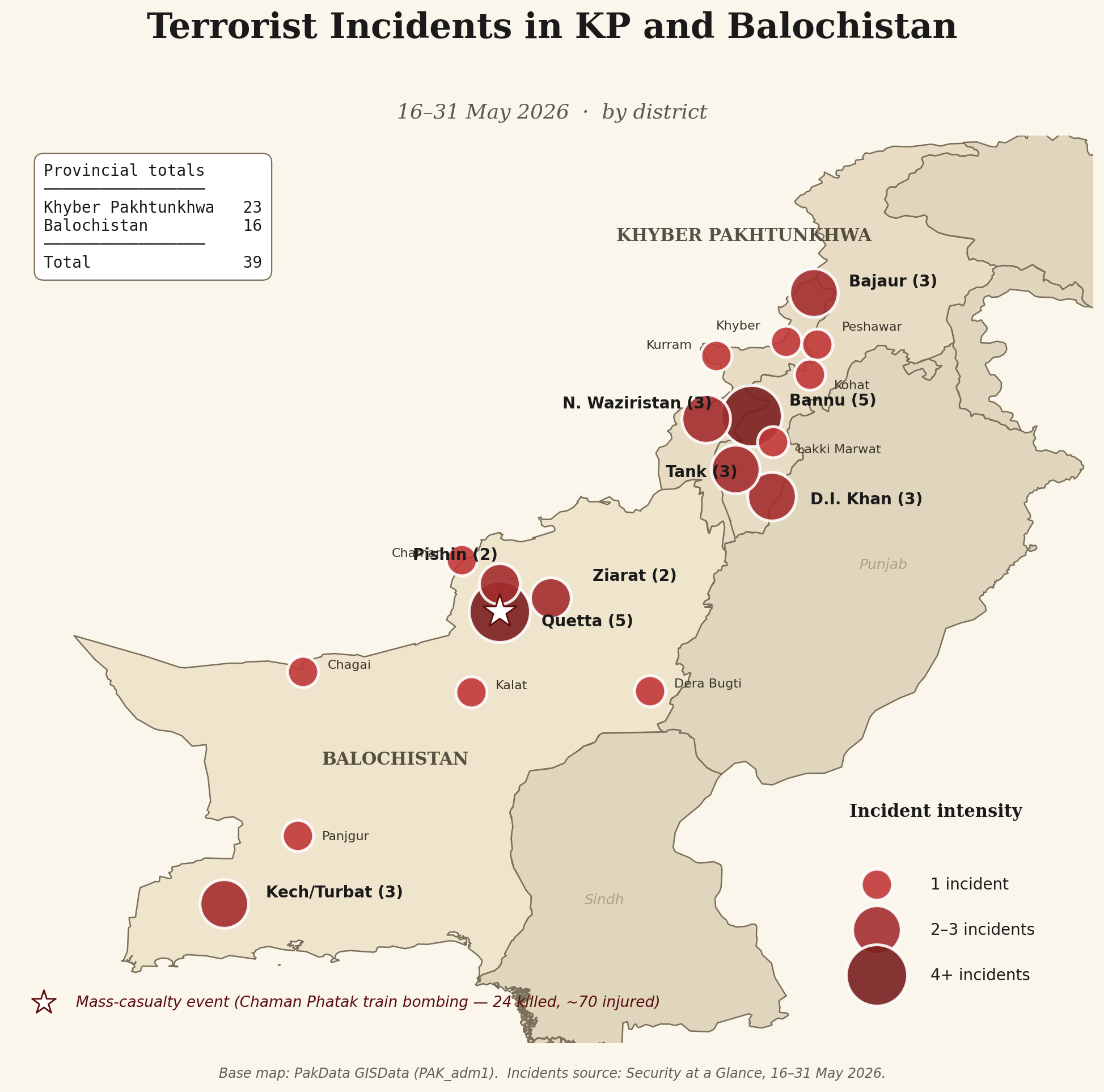
The fortnight of 16–31 May 2026 was dominated by an intense terrorist campaign in Khyber Pakhtunkhwa and Balochistan, with the suicide bombing of a passenger train near Chaman Phatak in Quetta on 24 May, claiming twenty-four lives and injuring nearly seventy, the single most catastrophic incident. Security forces sustained heavy casualties but also achieved significant kinetic results, killing scores of TTP and BLA militants across operations in North Waziristan, Bannu, Kurram, Ziarat, and elsewhere, and eliminating commanders linked to the earlier Quetta and Bannu attacks. At the institutional level, the government announced the raising of a WAPDA Security Force and the training of two hundred Federal Constabulary personnel in Saudi Arabia. Diplomatically, the period was marked by Prime Minister Shehbaz Sharif’s four-day visit to China and Field Marshal Asim Munir’s mediation visits to Tehran, set against the backdrop of an ongoing US-Iran ceasefire that began on 8 April 2026 following a war in which Iran’s Supreme Leader was killed and over twenty thousand Iranians reportedly perished. Pakistan-Afghanistan relations remained strained, with Islamabad demanding written guarantees against TTP and BLA cross-border attacks. India’s Army Chief issued a provocative warning to Pakistan, drawing a sharp ISPR response, while US Defense Secretary Pete Hegseth at the Shangri-La Dialogue praised Pakistan’s leadership and characterised the bilateral relationship as a developing “true friendship.” The fortnight closed with the resignation of US Director of National Intelligence Tulsi Gabbard.
DOMESTIC
BALOCHISTAN
- Unidentified gunmen killed three people and injured five others in an attack on a vehicle in Panjgur’s Gwarago area (15.5.26).
- CTD police constable Shakeela was martyred, while her husband and child were injured in a shooting attack in Turbat (17.5.26).
- Security forces reportedly killed 35 militants, arrested three commanders, and destroyed hideouts during an operation in Ziarat district (17.5.26).
- Authorities arrested 28 Afghan nationals for illegal stay in Kech district and handed them over to the FIA (20.5.26).
- TTP commander Baseer, accused in the Quetta FC headquarters suicide attack, was killed in a gun battle near Quetta/Pishin (21.5.26).
- Three mutilated bodies, suspected to be those of abducted Reko Diq Mining Company employees, were found in Chagai district (22.5.26).
- Armed attackers torched five coal trucks in Ziarat and abducted three people, including a police SHO (22.5.26).
- An ASF officer from Quetta airport was reportedly abducted in Kalat district while travelling to Karachi (22.5.26).
- Unknown saboteurs blew up a gas pipeline in Dera Bugti’s Mondrani area (23.5.26).
- Thirteen terrorists were killed, while four CTD personnel were martyred, in operations near Quetta and Pishin (23.5.26).
- The Vice Chancellor and officials of the University of Gwadar were safely recovered after being missing for around ten days (24.5.26).
- Gunmen seriously injured Police Head Constable Habib-ur-Rehman during polio security duty in Chaman (24.5.26).
- A suspected BLA suicide blast targeting a passenger train near Chaman Phatak crossing in Quetta killed at least twenty-four people and injured nearly seventy others (24.5.26).
- Five members of a family, including a woman, were allegedly shot dead by a relative in Quetta’s Kachhi Baig area (25.5.26).
- Unidentified assailants killed a man, Kifayatullah, and set his shop on fire in the Sanni area of Quetta (30.5.26).
- Police recovered the bodies of three men — Ustad Muhammad Siraj Kalanchi, Sirdal, and Attaullah — from separate locations in Pasni and Kech districts. Meanwhile, Jamaat-e-Islami MPA Maulana Hidayatur Rehman alleged that his cousin’s son, Siraj, had been abducted before being killed, claiming the incident was intended as a warning to him over his political and social activism (30.5.26).
Comments & Analysis:The fortnight in Balochistan presents the now-familiar dual character of the province’s security crisis: a high tempo of kinetic results against militants (notably the Ziarat operation killing thirty-five and the Quetta-Pishin operations killing thirteen) set against a steady drumbeat of high-impact attacks against civilians and security personnel. The Chaman Phatak train bombing is the strategic event of the fortnight: a suicide attack targeting a passenger train, with mass casualties, represents a deliberate escalation in the BLA’s targeting profile from infrastructure and security forces toward soft civilian targets. The discovery of mutilated bodies of Reko Diq employees in Chagai signals continued BLA pressure on foreign and mining interests, consistent with the strategic objective of making the province ungovernable and uninvestable. The killing of a CTD constable on duty with a polio team, and a head constable on polio security, illustrates the persistence of the campaign against the polio programme. The Maulana Hidayatur Rehman allegation, if substantiated, raises the possibility of targeted intimidation of political activists, a category of incident that requires careful investigation rather than partisan handling.
KHYBER PAKHTUNKHWA (KP)
- Police said five high-value terrorists, including banned TTP commander Hayatullah, were killed in an IBO linked to the suicide attack in Bannu that had martyred fifteen policemen (16.5.26).
- Security forces killed two wanted TTP terrorists, Iqbal Bali and Munir, in Kulachi, Dera Ismail Khan (17.5.26).
- Police advised ANP leader Mian Iftikhar Hussain to restrict his movement due to worsening security threats in KP (17.5.26).
- Unidentified assailants martyred Constable Abdul Aziz outside Yarik Police Station in Dera Ismail Khan (18.5.26).
- FC personnel Munsab Khan was martyred by unknown shooters in Alikhel village of Tank district (18.5.26).
- Wildlife Department employee Dil Jan was martyred by unidentified gunmen in the Wanda Zulu area of Tank district (18.5.26).
- Security forces killed twenty-two TTP terrorists during operations in the Shewa area of North Waziristan (17–19.5.26).
- Police arrested three militant facilitators and destroyed their hideouts in various locations, including Sandakhel and Pindikhel, during operations in Bannu district (19.5.26).
- Constable Imtiaz Khan was martyred by unidentified gunmen in the Barakholzu area of Bajaur district (19.5.26).
- Eighteen militants, including commander Mumtaz Imti, were killed in clashes in central Kurram (20.5.26).
- Security forces killed four terrorists, including commander Umar alias Jan Mir (carrying a head money of three million rupees), in the Spinwam area of North Waziristan (20.5.26).
- Unknown motorcyclists attacked a Peshawar Police investigation team near Northern Bypass, killing three detained suspects wanted in bank robbery, murder, and terrorism cases, before fleeing the scene (21.5.26).
- Two children were killed in an alleged drone strike in Shahi Tangai, Bajaur (21.5.26).
- Two schoolchildren were killed in a quadcopter strike in Bajaur district (21.5.26).
- A police officer, Akakhail Shah, was martyred by armed motorcyclists in Bara, Khyber district (22.5.26).
- Police and CTD, in a joint operation, killed twelve outlawed suspected TTP terrorists, including commander Abdullah, during a clash in Bannu district, with four police officials and one civilian sustaining injuries. In addition, a 10 kg IED recovered near Gul Zaman mosque on Miranshah Road in the district was also defused (23.5.26).
- Two terrorists were killed and one injured in an operation in Lakki Marwat district (23.5.26).
- Eleven TTP terrorists were killed during a 48-hour operation in the Datta Khel area of North Waziristan district (24.5.26).
- Four peace committee members were killed and one abducted by suspected banned TTP-affiliated terrorists in Kulachi tehsil of Dera Ismail Khan (25.5.26).
- A government school and a Basic Health Unit were blown up with explosives by unknown miscreants in Tank district (25.5.26).
- KP Police Chief Zulfiqar Hameed said Bannu Police were being strengthened with advanced surveillance systems as they remained on the frontline against terrorism. He confirmed the deployment of fifty modern devices, including thermal weapon sights, night-vision equipment, quadcopters, and anti-drone guns, along with the ongoing procurement of additional surveillance tools (25.5.26).
- Three people, including Frontier Corps personnel Ghazi Rehman, were martyred in separate firing incidents in Bannu district (27.5.26).
- Security forces reportedly killed five terrorists, identified as Daud, Hamza, and Afghan nationals Qari Zeentullah and Qari Lawangin, allegedly linked to the Tariq Gidar faction of the outlawed TTP, during an operation in Darra Adamkhel in Kohat district (29.5.26).
Comments & Analysis:
The KP fortnight reads as the most operationally active counter-terrorism theatre in the country, with several dozen militants neutralised across multiple districts. Three patterns deserve attention. First, the targeting of peace committee members in Kulachi is significant: peace committees are a cornerstone of community-based counter-insurgency, and their elimination is an attempt to break the link between the state and the tribes that has historically been the deepest source of state legitimacy in the area. Second, the destruction of a government school and a Basic Health Unit in Tank reflects the classic Taliban strategy of denying the state its civilian presence, ensuring that wherever the rifle leaves, the school and the clinic do not return. Third, and most troubling, the death of children in drone and quadcopter strikes in Bajaur within twenty-four hours raises questions that require institutional honesty: if these were friendly-fire incidents from security force quadcopters, transparent investigation is essential; if they were militant strikes, the proliferation of armed UAV capability among the TTP is an operational evolution of strategic significance. The KP Police Chief’s announcement of advanced surveillance and counter-drone deployment in Bannu is a welcome response, but the lesson of recent months is that technology alone cannot substitute for community trust.
Violence against civilians and security personnel in Balochistan and KP, mainly inhabited by Baloch and Pashtun populations, is unjustifiable and requires firm state action, while lasting peace also depends on addressing the political alienation and grievances that fuel unrest and external influence. A fair process, stronger public vigilance, re-engagement with constitutional Baloch leaders, and improved human and technical intelligence on the advance plans of terrorist outfits — accompanied by the presentation of concrete proof of the involvement of militant groups and their alleged support from foreign countries before the world, including China, Russia, and the USA, as well as the media — would contribute substantially to improving stability and reducing extremism, not only in Balochistan but also in KP.
PUNJAB
- Police registered a case against two unidentified motorcyclists for allegedly opening fire on the DHA Lahore residence of Supreme Court lawyer Balakh Sher Khosa, son of former Punjab Governor Latif Khan Khosa, after they attempted forced entry and issued threats before fleeing (18.5.26).
- A four-year-old child, Abdul Waqas, kidnapped seven days earlier from Pirmahal tehsil in Toba Tek Singh, was recovered after an encounter in which one suspect was killed and another injured (18.5.26).
- CTD police arrested two suspected militants, Mukhtiar Shah and Muhammad Younas, linked to the banned TTP, during separate operations in Sahiwal, recovering explosives and objectionable material (18.5.26).
- Suspected TTP terrorists attacked the Border Military Police (BMP) station in Chitarwata, Dera Ghazi Khan, damaging the building, though all personnel remained safe as security forces cleared the area and tightened security (19.5.26).
- A youth, Hadi Hassan, was reportedly kidnapped along with his car in Dera Ghazi Khan by members of the Ladhi gang, who demanded twenty jobs at DG Cement and a mobile tower in their village (20.5.26).
- A metro bus was destroyed after catching fire near 6th Road station in Rawalpindi, though no passengers were injured (23.5.26).
- CTD Lahore arrested thirteen suspected terrorists, including Mukhtar Ahmed, linked to banned groups such as TTP, during week-long intelligence-based operations across Punjab (23.5.26).
Comments and Analysis — Punjab
Punjab continues to exhibit the spillover of the western theatre into the heartland, both ideologically (CTD arrests of TTP-linked operatives in Sahiwal and Lahore) and geographically (the TTP attack on a BMP station in DG Khan, an early signal of the south Punjab–Balochistan corridor becoming an active operational space). The Ladhi gang demand of “twenty jobs at DG Cement and a mobile tower” is a vivid illustration of the gang-extortion economy in tribal-borderland Punjab, where criminal demands are framed in the patois of patronage politics. The targeting of a Supreme Court lawyer’s residence is a separate category of concern and should not be conflated with the militancy file pending investigation.
SINDH
- Police claimed to have arrested a suspect, Sada Hussain Fareedabad, along Suhag Wah on Fareedabad Road in Dadu district, who was wanted in a case pertaining to the killing of three policemen (16.5.26).
- Four coaches of the Sukkur Express derailed near Abad Station in Jacobabad, causing panic among passengers, though no injuries were reported (18.5.26).
- Unidentified armed motorcyclists shot dead prayer leader Fateh Muhammad near Ghaghar Phatak within the limits of Steel Town Police Station in Karachi (18.5.26).
- Police, supported by a federal agency, arrested suspected arms supplier Asim Pathan, a resident of Peshawar, along with a large cache of arms and ammunition near the New Bus Terminal area in Larkana (19.5.26).
- A court remanded suspected cocaine dealer Anmol alias Pinky in police custody for three more days in various drug cases, after she was produced at Karachi Central Prison’s judicial complex under tight security with media barred. Consequently, after the next hearing, she was sent to prison on judicial remand in connection with one murder case and nineteen narcotics cases (19, 22.5.26).
- Excise Department Inspector Hamid and seven others were arrested by police in the Brigade area over alleged involvement in short-term kidnappings of citizens for ransom. The gang had reportedly been active for about five months, targeting citizens for extortion (22.5.26).
- Human rights activist Saad Edhi, son of the late Abdul Sattar Edhi, returned to Karachi after being detained by Israeli forces during the interception of the Global Sumud Flotilla bound for Gaza in the eastern Mediterranean, and later deported to Türkiye with other activists by Israel (23.5.26).
Comments and Analysis — Sindh
Sindh’s fortnight reflects the city’s more diverse threat landscape: a mix of organised crime, sectarian targeting, and corruption-enabled criminality, alongside one notable item with international dimensions. The arrest of an Excise Inspector at the head of a kidnapping ring is a reminder that organised crime in Karachi continues to draw on insider participation from state functionaries, a problem that no kinetic operation will solve without institutional reform. The detention of Saad Edhi by Israeli forces is a symbolic moment with implications for Pakistan’s public diplomacy on the Gaza file and deserves careful framing in official communications.
AZAD JAMMU AND KASHMIR (AJK)
- PTI leader and former Chairman of the Zakat and Ushr Committee, Ch. Adalat, was reportedly shot dead by unidentified armed men in an ambush in Barnala tehsil of Bhimber district (21.5.26).
Comments and Analysis: A targeted political killing in AJK is an unusual occurrence and warrants a thorough investigation by the AJK authorities. While such incidents often reflect localised political or personal disputes, the political profile of the victim places this in a category that requires transparency to prevent speculation.
SECURITY
WAPDA Security Force
- The government has decided to establish a new WAPDA Security Force under the WAPDA Security Force Act, 2026, to protect key water infrastructure, personnel, and Chinese workers on major projects, including dams and power plants. The force will operate nationwide under federal oversight, coordinating with security agencies, and is likely to be led by a DG from the armed forces to address threats such as those faced at the Dasu Hydropower Project (24.5.26).
FC Personnel Training in Saudi Arabia
- The Interior Ministry said that 200 personnel from the Federal Constabulary’s Special Diplomatic Protection Unit would be trained in Saudi Arabia following a decision made during a meeting between Interior Minister Mohsin Naqvi and his Saudi counterpart Abdulaziz bin Saud Al Saud in Mina, where the Saudi minister also congratulated Naqvi on performing Hajj (28.5.26).
Comments and Analysis: Two institutional developments of consequence. The WAPDA Security Force is a long-overdue institutional response to the persistent targeting of water and energy infrastructure, including Chinese workers, and follows the pattern set by the Special Protection Unit and the Sindh Rangers’ Special Security Division. Its effectiveness will depend on whether it is given operational autonomy and adequate intelligence support rather than being absorbed into the existing bureaucratic frictions. The training of FC personnel in Saudi Arabia is a useful capability development, but more significantly signals the deepening of Pakistan-Saudi security cooperation in the wake of the regional realignments triggered by the Iran-US war.
MILITARY, DEFENCE AND STRATEGIC INITIATIVES
Army
- ISPR sharply reacted to the Indian Army Chief’s statement that “Pakistan should decide if it desires to be part of geography and history.” In response, it said that Pakistan strongly rejected the Indian COAS’s remarks, calling them provocative, irresponsible, and a threat to regional peace. It said Pakistan was a sovereign nuclear state and an integral part of South Asia’s geography and history. Pakistan also warned that any attempt to target the country could have serious and far-reaching consequences for the entire region (17.5.26).
- Prime Minister Shehbaz Sharif visited the Command and Staff College in Quetta, where he praised the Pakistan Armed Forces’ professionalism and sacrifices, reaffirmed national defence resolve, and highlighted ongoing counter-terrorism efforts, regional stability, and diplomatic cooperation. Earlier, upon arrival at the Command and Staff College, he was received by COAS and CDF Field Marshal Syed Asim Munir (19.5.26).
- The same day, COAS and CDF Field Marshal Syed Asim Munir visited Quetta Garrison and addressed officers at the Command and Staff College, praising its training and professionalism. He highlighted modern warfare, emerging technologies, and the need for multi-domain readiness and continuous training. He met troops in Balochistan and reaffirmed the commitment to eliminating terrorism with public support. He said Pakistan’s progress could not be stopped by propaganda, fake news, or externally sponsored threats. He stressed sustainable peace in Balochistan through development, governance, and strong civil-military coordination (19.5.26).
- An investiture ceremony was held at GHQ Rawalpindi, where COAS and CDF Field Marshal Syed Asim Munir conferred military awards, including Sitara-i-Imtiaz (Military) and Tamgha-i-Basalat, on officers, soldiers, and families of martyrs. He paid tribute to shuhada and ghazis, praising their sacrifices (21.5.26).
- COAS and CDF Field Marshal Syed Asim Munir arrived in Tehran as part of ongoing mediation efforts and was received by Iran’s Interior Minister Eskandar Momeni and Pakistan’s Interior Minister Mohsin Naqvi. He concluded a short official visit to Iran focused on mediation and regional de-escalation, meeting Iranian leaders including President Masoud Pezeshkian, Speaker Mohammad Bagher Ghalibaf, Foreign Minister Abbas Araghchi, and Interior Minister Eskandar Momeni. The talks focused on advancing a consultative peace process and reportedly made encouraging progress toward a final understanding, with Iran appreciating Pakistan’s role in promoting regional stability (22, 23.5.26).
- The COAS and CDF spent Eid-ul-Azha with frontline troops in Balochistan’s Zhob, offering prayers for national peace and paying tribute to the sacrifices of the armed forces. He condemned the Quetta suicide bombing, saying that such “inhumane and brutal” acts could not weaken the resolve of Pakistan’s armed forces or the nation (27.5.26).
Navy
The Pakistan Navy Investiture Ceremony 2026 was held in Karachi, where Admiral Naveed Ashraf conferred Sitara-i-Imtiaz, Tamgha-i-Imtiaz, Tamgha-i-Khidmat, and commendation awards on naval personnel. The event was attended by senior military officers, retired personnel, and the families of awardees in recognition of distinguished service (20.5.26).
Air Force
Chief of Staff of the Pakistan Air Force, ACM Zaheer Ahmed Baber Sidhu, visited Türkiye and held high-level meetings with Turkish defence leadership, including discussions on stronger military cooperation and joint training. He also met General Ziya Cemal Kadıoğlu and Defence Minister Yaşar Güler, among others, to expand collaboration in aerospace innovation, UAVs, and emerging defence technologies (22.5.26).
Youm-e-Takbeer
On the twenty-eighth anniversary of Youm-e-Takbeer, Pakistan’s military leadership, including Field Marshal Syed Asim Munir, Admiral Naveed Ashraf, and Air Chief Marshal Zaheer Ahmed Baber Sidhu, extended heartfelt felicitations to the people of Pakistan on behalf of the Armed Forces. They highlighted the 1998 nuclear tests as a symbol of unity, scientific achievement, and a commitment to national defence, peace, and stability (27.5.26).
Comments and Analysis — Military and Defence
Three threads stand out. First, the ISPR rejoinder to General Dwivedi’s “geography or history” remark was firm but measured, and the subsequent decision of senior leadership to spend time on the western front (the Quetta visits) was a calculated signal that the eastern rhetoric would not be allowed to distract from the counter-terrorism campaign. Second, Field Marshal Munir’s Tehran visit is a significant continuation of Pakistan’s mediation track, and his being received by both Iranian and Pakistani interior ministers is itself a marker of the channel’s depth. Third, the Youm-e-Takbeer commemorations and the PAF Chief’s Türkiye visit, taken together with the Saudi training arrangement and the China visit elsewhere in this report, signal the consolidation of a Pakistan-Türkiye-Saudi-China security architecture that the country is quietly building in response to the regional realignments of 2025–26.
DIPLOMATIC DEVELOPMENTS, ECONOMY AND SIGNIFICANT EVENTS
- Deputy Prime Minister and Foreign Minister Ishaq Dar presented a Senate resolution reaffirming Pakistan-China friendship on the 75th anniversary of diplomatic ties, which was unanimously adopted, reaffirming the commitment to deepen cooperation across all sectors between Pakistan and China (19.5.26).
- Prime Minister Shehbaz Sharif visited Quetta to address an event at the National Defence and Staff College, meet the provincial leadership, and chair a Provincial Apex Committee meeting on the National Action Plan (19.5.26).
- The Prime Minister, in a statement at Islamabad, said Youm-e-Takbeer commemorated Pakistan’s emergence as a nuclear power on 28 May 1998, restoring the strategic balance in South Asia through unity, resolve, and courage. Youm-e-Takbeer marks Pakistan’s nuclear tests conducted in Chagai, Balochistan, in 1998.
Pakistan-US Relations
US Defense Secretary Pete Hegseth said the United States and Pakistan were developing a “true friendship,” praising PM Shehbaz Sharif and Field Marshal Syed Asim Munir for their role in facilitating US-Iran peace negotiations. Speaking at the Shangri-La Dialogue in Singapore, he said Washington did not view either Pakistan or India as a threat and appreciated both countries’ contributions to regional and global peace (30.5.26).
Comments & Analysis: The Hegseth remarks represent the most positive characterisation of the Pakistan-US relationship by a senior American official in several years and are clearly tied to Pakistan’s role in the Iran mediation. The challenge for Islamabad will be to translate this transactional warmth into durable strategic dividends — economic, technological, and military — before the next inevitable turn in American attention. The Senate resolution on Pakistan-China ties, on the 75th anniversary, is the formal counterpart to the Prime Minister’s substantive engagement in Beijing covered below; the dual-pillared approach to China and the US, conducted in the same week, is statecraft of a kind that has not always been visible in Pakistan’s recent foreign policy.
REGIONAL
AFGHANISTAN
Law and Order / Security
- Two children were killed and their mother injured when an unexploded device detonated in Helmand. A former Afghan Deputy Defence Minister was detained over the alleged murder of two women, while the Afghanistan Freedom Front claimed a rocket attack on a Taliban base at Kabul military airport. Separately, four people, including a commander’s son, were killed in a clash near Kabul’s Sarai Shahzada market, with police citing a personal dispute and arresting two suspects. The IEA Supreme Leader reiterated that Afghanistan would not compromise on Islam or Sharia but remained open to engagement within an Islamic framework (20, 23, 24, 27.5.26).
- IEA Rehabilitation Minister Abdul Latif Mansoor met Chinese Ambassador Zhao Xing in Kabul to discuss expanding infrastructure cooperation, including the Wakhan Corridor road project linking Afghanistan and China. In a separate move, China also imposed export restrictions on several chemicals to Afghanistan and other countries, requiring special permits for controlled substances including ammonium chloride and palladium chloride (17, 24.5.26).
- Iranian airline SAHA launched weekly direct flights between Mazar-e-Sharif and Mashhad, while Britain said it would recognise the Islamic Emirate only after progress on human rights and security, including women’s education. India sent twenty tons of medical supplies to Afghanistan, with Norway also urging similar humanitarian standards, and further aid shipments expected. An unconfirmed report claimed Russia’s FSB alleged that ISIS-K and other factions were working against the Taliban with British intelligence support. Afghanistan and Russia signed a military-technical cooperation agreement in Moscow to enhance defence ties. The agreement was reportedly signed during a meeting between IEA Defence Minister Mawlawi Mohammad Yaqoob Mujahid and Secretary of the Russian Security Council Sergei Shoigu on the sidelines of the Moscow International Security Conference. Upon returning to Kabul, Mujahid said implementation of the agreement would begin soon and would focus on maintaining and upgrading Russian-made military equipment, while strengthening Afghanistan’s defence capabilities, sovereignty, and regional stability. The Governor of Iran’s Khorasan-e-Razavi province, Gholam Hossein Mozaffari, during talks with Afghanistan’s Consul General Noor Muhammad Mutawakkil at Mashhad, said that stronger trade, joint investment, and economic cooperation between Iran and Afghanistan were essential for boosting economic growth and leveraging their longstanding cultural and economic ties. He added that Mozaffari emphasised the strategic importance of the Islam Qala Border Crossing and said infrastructure upgrades and operational improvements were being pursued to boost trade and cross-border movement between Iran and Afghanistan (20, 25, 26, 28, 30.5.26).
Pakistan-Afghanistan Relations
Pakistan Foreign Office spokesperson Tahir Andrabi said that its policy toward the Taliban would not change unless Afghan territory was no longer used for militant attacks, with Islamabad demanding written guarantees and citing continued violence by groups such as the TTP and BLA (22.5.26). China, Russia, and Central Asian states remain concerned about militant groups operating from Afghan territory, while Pakistan has pressed the Taliban-led Afghan Government to stop cross-border attacks by the TTP and BLA, leading to border closures and Operation Ghazab lil-Haq in 2026. Meanwhile, China and Russia continue strengthening engagement with Kabul, particularly in the economic field, while Russia, besides extending recognition, has also concluded a technical and military agreement with the Taliban government. However, Beijing is reportedly still mediating between Pakistan and Afghanistan through the “Urumqi process” to ease tensions and improve trade and security. Analysts are divided in their opinion; however, some believe prolonged border closures and trade restrictions could further expand Russian, Iranian, and Indian influence in Afghanistan, deepening Pakistan’s estrangement from the Taliban-led government (22, 30.5.26).
Comments & Analysis:Three strategic currents are now visible in the Afghan theatre. First, Russia has moved from cautious engagement to active military-technical cooperation with the Taliban, a development that would have been unthinkable in earlier decades and that materially alters the calculus of every other external actor. Second, China’s continued infrastructure diplomacy, particularly the Wakhan Corridor project, indicates Beijing’s long-game commitment to absorbing Afghanistan into the wider Belt and Road framework, even as it imposes new chemical export controls to address the precursor problem. Third, Pakistan’s policy is now formally conditional on written guarantees against cross-border attacks, a posture that is principled but operationally difficult to enforce. The deeper concern, captured in the cited analyst view, is that prolonged Pakistan-Afghanistan friction creates space for Russia, Iran, and India to expand their footprints in Kabul, a structural shift that would diminish Pakistan’s traditional leverage in Afghan affairs. However due to Afghan Taliban’s persistent support to the terrorist group TTP, that has killed a large number of Pakistani citizens, police and military officers, Pakistan is left with no other choice but to take all measures to annihilate them inside Pakistan and Afghanistan.
CHINA
China-Russia Relations
- Russian President Vladimir Putin visited Beijing on a two-day trip (19–20 May) to meet Chinese President Xi Jinping to strengthen economic cooperation and the strategic partnership, with both leaders praising “unyielding” and “friendly” ties and calling for deeper long-term coordination and improved global governance. During the talks, they signed agreements on trade, media, and energy, discussed Ukraine, Iran, the United States, and the proposed “Power of Siberia 2” pipeline, while Xi urged a global ceasefire and Putin emphasised Russia’s role as a reliable energy supplier, highlighting growing China-Russia alignment since 2022 amid shifting global geopolitics (19, 20.5.26).
Pakistan-China Relations
- Prime Minister Shehbaz Sharif visited China for four days, meeting Chinese Premier Li Qiang and President Xi Jinping at the Great Hall of the People in Beijing. The discussions focused on strengthening bilateral ties, regional stability, economic cooperation, and marking 75 years of diplomatic relations, with Pakistan highlighting its mediation role. President Xi praised the “all-weather” strategic partnership, called Shehbaz Sharif an “old friend,” and reaffirmed China’s support for Pakistan. COAS and CDF Field Marshal Syed Asim Munir also attended the meeting, with Xi appreciating Pakistan’s regional peace efforts following his return from Iran. China and Pakistan also reportedly pledged closer coordination on Afghanistan after high-level talks in Beijing, stressing that Afghan territory must not be used by militant groups to threaten regional security. The joint statement said that Pakistan and China had reached a broad consensus on deepening their all-weather strategic cooperative partnership and enhancing coordination on regional and international issues (27.5.26).
Comments & Analysis : The simultaneity is striking: Putin in Beijing on the 19th–20th, Shehbaz Sharif in Beijing on the 27th, and Field Marshal Munir present at the latter engagement following his Tehran mediation visit. This is not coincidence. Beijing is positioning itself as the indispensable convening power for the Eurasian security architecture taking shape after the Iran-US war, with energy (Power of Siberia 2), trade, and regional stability as the connective tissue. For Pakistan, the elevation of “regional peace efforts” to the level of explicit Chinese praise is significant: it converts the mediation role from a transactional service to the United States into a strategic asset acknowledged by both Washington (via Hegseth) and Beijing (via Xi) within the same week, a rare diplomatic achievement.
ILLEGALLY INDIAN OCCUPIED JAMMU AND KASHMIR (IIOJK) / LOC
Sheikh Ghulam Hassan of Tarigam, a respected Kashmiri Islamic scholar and former Ameer of Jamaat-e-Islami Jammu and Kashmir, passed away on 16 May after a prolonged illness in Kulgam. His death prompted widespread condolences across the Kashmir Valley from religious, social, and political figures. Jamaat-e-Islami Jammu and Kashmir was banned in 2019 under the UAPA, with the ban later extended in 2024. The government cited alleged links to terror groups, secessionist ideology, and activities against India’s sovereignty. PDP president and former CM IIOJK Mehbooba Mufti condemned the harsh behaviour of police towards mourners during the burial (19.5.26). Later, she criticised the government for placing Mirwaiz Umar Farooq under house arrest in Srinagar on Eid-ul-Adha, calling the move unjust (27.5.26).
The National Investigation Agency (NIA) conducted searches at three locations in Srinagar and Shopian in a terror funding case linked to the banned Jamaat-e-Islami, recovering financial documents and electronic devices as part of its probe into alleged funding and support for separatist and terrorist activities in IIOJK (25.5.26).
Comments & Analysis: The fortnight in IIOJK is characterised by the continuing closure of political and religious space, with the house arrest of Mirwaiz on Eid and the obstruction of mourners at the funeral of a respected scholar serving as reminders that the security architecture installed since 2019 retains its grip on Kashmiri civic life. Nevertheless, the reaction of the Kashmiris is continuing. The continued NIA pressure on Jamaat-e-Islami networks indicates that the post-2019 strategy of organisational dismantlement is now in a long-tail enforcement phase. Mehbooba Mufti’s continued public criticism is, for now, one of the few mainstream voices keeping these issues in the Indian national conversation.
INDIA
Military, Defence and Strategic Initiatives
- The Chief of the Indian Army Staff, General Upendra Dwivedi, warned Pakistan over alleged support for terrorism, saying it must choose between “geography or history” and cautioning of a strong response to any provocation amid ongoing tensions. He also inaugurated a CLAWS seminar in New Delhi on “Security to Prosperity,” focusing on smart power, while analysts termed his remarks ahead of his retirement in 2026 as politically driven and of limited significance. Later, the COAS, speaking to newsmen in Pune, said the Indian armed forces were fully prepared for “Operation Sindoor 2.0” if required and were enhancing joint readiness for future multi-domain warfare beyond land, air, and sea, including cyber and space domains (18–19, 30.5.26).
- The Indian Strategic Forces Command successfully tested the Agni-I ballistic missile, with a range of 700–1,200 km and capable of carrying conventional and nuclear warheads, from the Integrated Test Range at Chandipur, Odisha (22.5.26).
- India’s Home Minister, Amit Shah, has ordered the strict demolition of all illegal constructions within 0–15 km of the Pakistan border, directing authorities to intensify action against infiltration, smuggling, encroachment, terror financing, and other cross-border crimes during a visit to Rajasthan (27.5.26).
- Lt Gen N. S. Raja Subramani (Retd) assumed charge as Chief of Defence Staff and Secretary of the Department of Military Affairs, succeeding Gen Anil Chauhan after his tenure ended (30.5.26).
- Admiral Krishna Swaminathan assumed charge as India’s new Chief of the Naval Staff, succeeding retired Admiral Dinesh Kumar Tripathi, amid evolving regional maritime security conditions (30.5.26).
Diplomatic Developments and Significant Events
- PM Narendra Modi’s five-nation tour (15–20 May) secured around $40 billion in investments and expanded cooperation in energy, defence, AI, semiconductors, and green technology with the UAE and European partners (21.5.26).
- US Secretary of State Marco Rubio visited India for high-level talks with PM Modi, External Affairs Minister Jaishankar, and NSA Ajit Doval, focusing on trade, technology, defence, and the Quad partnership amid efforts to strengthen India-US relations. Analysts noted India’s balancing act between the US and Russia, with some tensions over trade, defence, and strategic trust despite ongoing cooperation under the Comprehensive Global Strategic Partnership (24.5.26).
- Meanwhile, political discourse in India saw controversy over the viral “Cockroach Janta Party” — a satirical movement founded by Abhijit Dipka — reflecting youth frustration over unemployment and governance issues (25.5.26).
- NSA Ajit Doval, speaking at a security forum in Moscow hosted by Sergei Shoigu, called for decisive global action against terrorism and said there must be no “double standards” in combating it, urging countries to take a clear stand against terrorism sponsors (30.5.26).
- Indian Muslims, who form the largest minority in India, have been facing a continuous decline in representation. Comprising about 14 per cent of India’s population, they are reported to be significantly underrepresented in Parliament, state assemblies, and public institutions, with Lok Sabha representation around 4.4 per cent and state assembly representation averaging about 7 per cent, with some states having none. In the civil services, judiciary, military, security forces, and police, representation is estimated at roughly 3–5 per cent, influenced by electoral dynamics, political polarisation, and the absence of reserved quotas. Based on the 2011 Census and demographic projections, India’s population is about 1.43 billion, with Hindus making up around 79–80 per cent and Muslims about 14 per cent — roughly 200–210 million people. An article titled “A Minority in the Backyard of India,” written by security and current affairs analyst Dr Naveed Elahi discussing this issue, has been published in The Strategic Brief – International (thestrategicbrief.com) on 29 May 2026.
Comments & Analysis : The Indian fortnight is dominated by leadership transitions (a new CDS and a new Naval Chief), a high-profile Modi tour with a $40 billion investment headline, and the General Dwivedi rhetoric on Pakistan. The “geography or history” remark, read alongside Amit Shah’s 15-km demolition order on the border, suggests a deliberate hardening of the public posture against Pakistan even as backchannel signals (covered in earlier reports) move in the opposite direction. The Rubio visit confirms that the US-India track continues to advance on its own logic, independent of the warming US-Pakistan tone. The data on Indian Muslim representation, drawn from The Strategic Brief article, (an analysis of Karan Thappar’s article by Dr. Naveed Elahi) supplies the structural context for the political dynamics of contemporary India: a 14 per cent minority with 3–5 per cent representation in core state institutions is a configuration that no democracy can sustain without consequences for its long-term cohesion.
IRAN
- The US-Israel war with Iran, triggered by joint strikes on 28 February 2026, caused severe regional instability, including tensions around the Strait of Hormuz and heavy casualties in Iran, where over 20,000 people were reportedly killed and many others injured. Supreme Leader Ayatollah Ali Khamenei was killed during the conflict and succeeded by Mojtaba Khamenei, while Iran and the US later agreed to an indefinite ceasefire from 8 April. Israel continued strikes in Lebanon against Hezbollah- and Hamas-linked targets, resulting in over 3,200 casualties. Amid escalating tensions, Pakistan hosted the first direct US-Iran talks in 47 years, while Qatar, Saudi Arabia, GCC states, Russia, and China supported diplomatic efforts to prevent a wider conflict.
- Recent mediation efforts by Pakistan, backed by Saudi Arabia, Qatar, and Türkiye, brought the US and Iran closer to a potential agreement. However, the White House’s call for Saudi Arabia and Qatar to join the Abraham Accords complicated the process, while CENTCOM reported continued strikes in southern Iran despite the ceasefire.
- Secretary of State Marco Rubio said negotiations could take several more days. Iran condemned the US attack on Bandar Abbas and voiced support for Oman following US threats related to the Strait of Hormuz. Iran’s Revolutionary Guard claimed it had targeted a US airbase after American strikes on an Iranian drone operation. Meanwhile, President Donald Trump said Iran had agreed not to pursue nuclear weapons while receiving a tougher proposal from the USA. On the other hand, Tehran reportedly seeks $12 billion in frozen assets and wants Lebanon included in any future regional peace agreement (27, 28, 30.5.26).
- Iran’s Deputy Parliament Speaker, Hamid Reza Haji Babayi, said the country should expand land and alternative trade routes, assuming the US naval blockade may continue. He stated that Iran was redirecting key imports through northern Caspian ports and using ports in Oman, Pakistan, and Türkiye to keep trade flowing (31.5.26).
Comments & Analysis:
(a) The US and Israel launched joint strikes on Iranian targets on 28 February, during which Supreme Leader Ayatollah Ali Khamenei was killed and later succeeded by Mojtaba Khamenei, while Iran and the US agreed to an indefinite ceasefire beginning 8 April. Israel continued bombing Beirut and South Lebanon, targeting Hezbollah leaders, infrastructure, and leadership, causing a death toll of 3,215 people. Besides this, the remaining Hamas leaders are also being targeted. Pakistan hosted the first direct US-Iran talks in 47 years in April and continues to push for diplomacy, even as the IRGC warns that it may retaliate over alleged US ceasefire violations.
(b) The Gaza and Iran conflicts have fuelled speculation that Arab and Islamic states are being pressured towards normalisation with Israel, while countries such as Saudi Arabia, Pakistan, and Türkiye continue to support a two-state solution. Though the Abraham Accords normalised ties between Israel and several Arab states to some extent, they did not resolve the Palestinian statehood issue, and many Muslims still view the Palestinian cause as a central point for delivering justice in the Middle East. According to several analysts, the White House, under pressure from Israel, is apparently misreading the situation and encouraging its allied and friendly countries to continue diplomacy for short-term strategic and economic reasons. However, lasting peace is unlikely without addressing Palestinian rights and aspirations for statehood. Despite this, diplomatic sources say Pakistan remains a leading candidate to host a potential United States–Iran peace signing if talks succeed.
(c) The Iran file remains the single most consequential strategic context of this fortnight. The casualty figure of over 20,000 Iranian dead, the death and succession of the Supreme Leader, and the indefinite ceasefire of 8 April together mark a generational rupture in the Middle Eastern order. Pakistan’s mediation role, sustained through Field Marshal Munir’s Tehran visit and Hegseth’s Singapore acknowledgement, has been a quiet but consequential diplomatic achievement. The Deputy Speaker’s remarks on routing trade through Pakistani ports, alongside the earlier opening of six land transit routes, indicate that economic integration between the two countries is accelerating as a byproduct of the crisis — a long-deferred development now being driven by necessity rather than strategy.
MIDDLE EAST
- The UAE has completed nearly 50 per cent of a second pipeline bypassing the Strait of Hormuz to increase ADNOC’s export capacity via Fujairah port. It is expected to become operational in 2027 amid regional tensions and efforts to secure alternative energy routes (21.5.26).
- Israel claimed it had killed Mohammed Odeh, the newly appointed head of Hamas’s armed wing in Gaza, in an airstrike. PM Netanyahu and Defence Minister Katz, in a joint statement, said the Hamas leader had served as Hamas intelligence chief during the 7 October attack and had recently succeeded Ezzedine al-Haddad (27.5.26).
- Israel claimed it had captured the 900-year-old Beaufort Castle on a strategic ridge in southern Lebanon and warned civilians to evacuate ahead of an expanded ground offensive. Israeli PM Netanyahu ordered a deep incursion in Lebanon to strike Hezbollah (31.5.26).
Comments & Analysis: The capture of Beaufort Castle and the order for a deep Lebanon incursion suggest that, notwithstanding the US-Iran ceasefire, the Israeli front against Hezbollah is moving into an expanded ground phase. Every time Iran and US come closer to reach an agreement for permanent end of war, Israel throws a spanner to undermine it. Israeli Defence forces have not stopped their forays in Gaza and Lebanon, resulting in deaths of civilians. President Trump is in a fix. The delays in talks and Israeli forays in Gaza and Lebanon can reignite the Iran-US skirmishes. The UAE pipeline reaching 50 per cent completion is the regional infrastructure response to the Hormuz vulnerability, and is consistent with the broader pattern of Gulf states quietly building options that reduce the geographic chokehold of the strait. The targeted killing of senior Hamas commanders continues as a parallel campaign.
Shangri-La Dialogue in Singapore
- Pete Hegseth, speaking at the three-day Shangri-La Dialogue, said the US and Pakistan were developing a “true friendship” and praised Pakistan’s leadership — Prime Minister Shehbaz Sharif and Field Marshal Syed Asim Munir — for its role in US-Iran peace efforts, while stating that Washington did not view either India or Pakistan as threats and valued both for regional peace. He also said the Asia-Pacific was the most important strategic region, highlighted improved US-China ties while warning against regional hegemony, and noted India’s growing military strength and US-India defence co-production. Forty-four countries attended the conference (30 May 2026).
Comments & Analysis: Hegseth’s remarks are the most significant public articulation to date of the post-Iran-war American repositioning toward Pakistan. The framing of US-Pakistan ties as a “true friendship” is notably warmer than the transactional descriptors that have characterised the relationship for over a decade. The challenge for Islamabad, as noted earlier, is durability: converting this favourable moment into structural gains before American attention shifts.
US National Intelligence Director Resigns
- Director of US National Intelligence Tulsi Gabbard resigned from her post effective 30 June, citing her husband’s rare bone cancer and the need to support him during treatment. President Trump praised her service, saying she “did an incredible job” and expressing that she would be missed. Principal Deputy Director Aaron Lukas will serve as Acting Director of National Intelligence after her departure on 30 June. Her exit makes her the fourth cabinet member to leave the administration amid broader political and policy tensions (23.5.26).
Comments & Analysis: Gabbard’s departure is significant institutionally rather than personally. Her tenure at ODNI was marked by visible tensions with the President over Iran assessments, in particular her congressional testimony that Iran was not building a nuclear weapon — a finding contradicted by the President in the run-up to the February strikes. The departure of a senior intelligence principal who held analytically robust but politically inconvenient positions illustrates the producer-consumer tension in intelligence that has been a recurring theme of this administration. Her replacement bears close watching.
EXECUTIVE SUMMARY: A CIVILIAN-LED STRATEGIC RESET FOR BALOCHISTAN
Strategic Vision
Decades of a hyper-securitized, paramilitary-first model in Balochistan have managed the symptoms of instability while inadvertently hollowing out local civilian governance, stifling economic growth, and worsening local alienation. To counter the Baluchistan Liberation Army’s (BLA) shifting tactics toward soft targets, the state must pivot to a **civilian-led, rule-of-law-based counter-terrorism (CT) and development framework**. This strategy shifts the focus from purely kinetic containment to local resource ownership, bureaucratic deregulation, and cross-border economic integration.
Core Pillars of the Transformation
1. Reaffirming Civilian Lead in Security & Rule of Law
Operational Devolution:Gradually transition internal security, urban policing, and counter-terrorism mandates from the Frontier Corps (FC) to the Balochistan Police and its specialized Counter-Terrorism Department (CTD).
Constitutional Realignment:Return paramilitary forces to their primary constitutional mandate—border security and external defense—while dismantling parallel administrative or municipal structures in civilian towns.
Institutional Trust: Establish independent, provincial judicial oversight committees to review security-related detentions, ensuring transparency to directly counter insurgent narratives.
2. Rapid Border Economic Integration (Iran-Pakistan SROs)
Formalizing the Border Economy: Fast-track the implementation of recent Statutory Regulatory Orders (SROs) to legalize and scale up cross-border trade with Iran, eliminating arbitrary bureaucratic bottlenecks and establishing formal currency-swap or barter channels.
Energy and Logistics Hubs: Build formal Liquefied Petroleum Gas (LPG) and fuel-handling hubs at major crossings like Taftan and Gabd, transforming informal networks into stable, tax-paying corporate employers.
Infrastructure Shift: Transition from a security-first “border fencing” mindset to an economic-first “border market” reality by constructing fully equipped marketplaces to provide youth with alternative livelihoods.
3. Economic Autonomy & Bureaucratic Deregulation
Chamber Empowerment: Shift regulatory authority from federal and provincial bureaucrats directly to regional Chambers of Commerce (Quetta, Gwadar, etc.), granting them independence to coordinate trade, issue licensing, and manage cross-border transport approvals.
Digital De-layering: Replace the corruption-prone “border token” and security pass systems with automated, digital customs platforms overseen jointly by local chambers and the Federal Board of Revenue (FBR).
Localized Wealth Supply Chains: Develop local logistics hubs and cross-stuffing yards near borders and ports to ensure transport and cargo-handling profits remain within the provincial economy.
4. Mineral Governance & Curbing Resource Plunder
Demilitarizing Extraction: Formally strip non-civilian institutions and paramilitary entities of administrative, regulatory, or lease-holding roles in the mining sector. Full governance must return to the provincial civilian Directorate General of Mines and Minerals.
Transparent CSR and Local Beneficiation: Legally mandate that a fixed, transparent percentage of gross mining revenues (from local quarries to mega-projects like Reko Diq) be deposited into localized trust funds. These must be managed by elected local government representatives—not federal boards—to fund schools, water, and healthcare within extraction zones.
Formalizing Small-Scale Mining: Protect local miners from exploitation and boost provincial revenue by introducing institutional credit, modern safety standards, and legal land titles for small-scale operators.
The Strategic Conclusion
Security operations can only clear physical space; they cannot build a lasting peace. True stability in Balochistan will remain elusive until the local population possesses absolute ownership over their resources, their trade, and their local administration under the protective umbrella of civilian law.
Answer to chaos is more democracy & Civilian Rule and local Ownership of assesta and wealth of the regions every where in Pakistan, specially so in Baluchistan & KPK