
Naveed Elahi
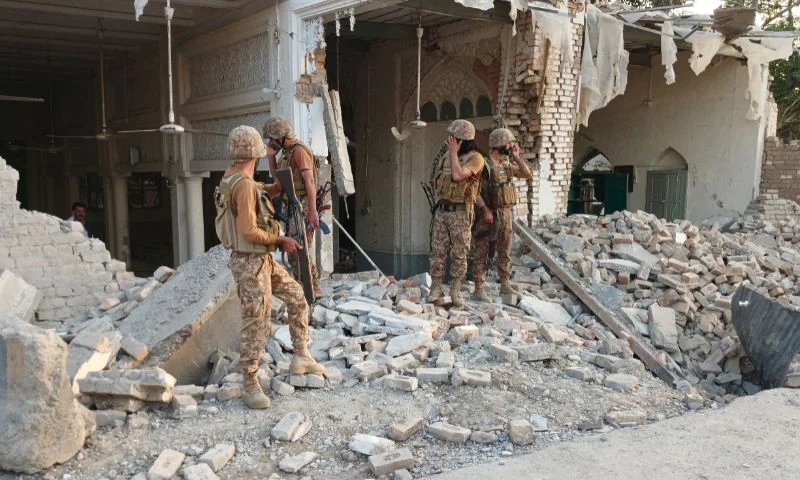
More than 28 people were martyred, including 16 policemen and over 100 injured when a suicide bomber detonated a Vehicle-Borne Improvised Explosive Device (VBIED) at the mosque inside the highly fortified Police Lines in Kohat, KP, during the Juma (Friday) prayers.
The mosque, packed with worshippers, collapsed under the impact of the blast. Rescue officials said the dead include police personnel, labourers, doctors, and children who had come for Friday prayers. The injured were shifted to DHQ Hospital Kohat and CMH, where several are in critical condition.
Police identified the suicide bomber as Matiullah, an Afghan national residing in Pakistan. The attack — which began with the VBIED blast at the boundary wall of the mosque and was followed by an armed assault by multiple attackers — was claimed by Ittehadul Mujahideen Pakistan (IMP), including Haji Gul Bahadar group.
This was not just a bombing. It was a complex, coordinated attack on the very symbol of the state’s security. After the bomb blast, gun battle continued for hours and the brave policemen and soldiers managed to subdue the assailants.
The Fitna That Knows No Mosque
It is irrelevant to ask a hackneyed question, how a Muslim can attack Muslims offering Juma prayers. That question assumes a moral framework these groups possess. They do not.
The Tehreek-e-Taliban Pakistan (TTP), formally formed in December 2007, and its affiliated networks including the Hafiz Gul Bahadur group — now officially designated as Fitna al-Khawarij — have long abandoned any ideological pretense.
Long before TTP was formally established, these fragmented groups were acting as errand-boys and facilitators of Al-Qaeda in the erstwhile FATA. Their history since is one of constantly shifting objectives: at times Sharia, at times revenge for Lal Masjid, for years struggle till the ouster of US forces from Afghanistan, at times opposition to military operations. But two motives have remained persistent and consistent: money and power.
Attacking a mosque on a Friday is not an aberration for them; it is their doctrine. From the 2015 attack on the Imambargah in Peshawar to the 2023 Peshawar Police Lines bombing, they have repeatedly targeted places of worship precisely because it maximises terror. Calling them Fitna al-Khawarij is therefore not rhetoric; it is a theological and legal classification. The Khawarij were those who declared other Muslims apostates to justify killing them.
IMP, which has claimed responsibility for the Kohat attack, is part of this same ecosystem. Its claim does not absolve TTP. In the current landscape, these groups operate like a franchise — sharing manpower, explosives, and sanctuaries, while swapping names to confuse investigators and dilute pressure on their leadership based in Afghanistan.
Sinister Afghan Taliban Support
Since August 2021, when the Afghan Taliban came to power, their policy towards Pakistan and Tehreek-e-Taliban Pakistan (TTP) has been clear. The TTP has been given shelter in Afghanistan, allowed to operate from Afghan soil, and provided logistical support to carry out terrorist attacks inside Pakistan. The Afghan Taliban leadership has adopted a policy of bleeding Pakistan to avenge its support for the US in the War on Terror. Ironically, it has completely ignored the fact that Pakistan harboured its members and saved them from total annihilation at the hands of US forces. They and their families, along with more than four million Afghan refugees, lived in cities across Pakistan, where they were provided with education, livelihoods and health facilities on par with Pakistan’s own citizens.
An analysis of numerous statements by the Afghan Taliban spokesperson, Zabihullah Mujahid, shows that he has brazenly brushed aside Pakistan’s concerns and even mocked them. He has behaved irresponsibly, issuing provocative statements and cared a fig for Pakistan’s sensitivities. Every Afghan-backed TTP attack in Pakistan, followed by a mocking statement from Zabihullah, has deepened the hostility and bitterness between the two sides. Pakistan has therefore been compelled to take stern measures against the Afghan Taliban. The Kohat incident will not go unavenged.
The Question We Always Ask Too Late
After every successful terrorist attack, we lament the failure of intelligence, and that question remains unanswered.
Today, however, the more relevant question is not just about intelligence but about security and accountability. How did a vehicle laden with hundreds of kilograms of explosives travel all the way to Kohat and enter the restricted premises of the Police Lines? How did terrorists, armed to the teeth, manage to enter the target area without being checked?
The Police Lines is not an ordinary public place. It is the district headquarters of the police, housing the families of police personnel, the armoury and the offices of senior officers. Its mosque should have been the most secure mosque in the district.
Why were proper security arrangements not in place to ensure that unauthorised persons and vehicles could not reach the boundary wall? Where were the perimeter checkpoints? Where was the vehicle screening? Was the CCTV coverage functional? How was a VBIED able to reach the most sensitive point of a high-security compound?
If a vehicle could reach the Police Lines in Kohat, it could reach anywhere. Shouldn’t heads roll this time round? Every such attack must lead to accountability, corrective action and prevention. It is high time to fix responsibility and take action.
The Investigation Must Answer Seven Questions
This is a complex attack that requires a complex investigation. Investigators, particularly the Counter Terrorism Department (CTD), must pursue several lines of inquiry simultaneously:
1. Identity and Origin of Attackers: Though the suicide bomber has been named as Matiullah, an Afghan national, his full identification through biometric and DNA confirmation is critical. What about the other attackers involved in the subsequent gun battle? What is their nationality, travel history, and when and how did they enter Pakistan? Where were they residing?
2. Affiliation Chain: Despite the claim by IMP, its affiliation must be confirmed. Was IMP acting independently, or was this a joint operation coordinated by TTP-linked factions? Intelligence agencies must establish the command and control link to the Afghanistan-based leadership, particularly the Hafiz Gul Bahadur network, which operates with impunity from across the border.
3. Handler and Training: Who recruited, trained, and handled these bombers? Where are the training camps and safe houses? The sophistication of a VBIED attack followed by a commando-style assault suggests professional training that is not available in Kohat.
4. Cross-Border Dimension: This is the most crucial part. What was the point of origin and the route into Pakistan? Which border crossing was used? Was it a porous, unguarded section of the Pak-Afghan border? Where was the planning and staging done on Afghan soil, and what did the Taliban authorities know? Despite repeated sharing of intelligence and formal protests, the Afghan Taliban continue to provide sanctuaries to TTP. This attack is proof that their assurances are worthless.
5. Logistics and Facilitation: A VBIED cannot be assembled overnight. Where were the explosives and the vehicle obtained and prepared? Who were the local facilitators inside Kohat who provided safe houses, transport, and reconnaissance of the Police Lines? Who financed the operation? The money trail must be followed. How many more VBIEDs ready to be launched at sensitive targets/
6. Security Lapses: An internal inquiry must be ordered into the security failure at the Police Lines. Was there prior threat intelligence about an attack on this specific installation, particularly on a Friday? Was it disseminated and acted upon? What was the response time and coordination of CTD and police during the ensuing gun battle that could have saved lives?
7. Target Selection: Why this particular mosque and compound? Was it chosen for its symbolic value — to erode police morale and show that even Police Lines are not safe? Was there an intelligence leak about the presence of specific CTD officers during Juma prayers? Or was it simply a soft target within a hard compound?
Beyond Condemnation
Kohat has been targeted before. Khyber Pakhtunkhwa has been bleeding for two decades. The pattern of attacking Police Lines and security compounds is deliberate. It is meant to break the will of the police force, which is on the frontline of this war.
We can call them Fitna al-Khawarij, we can condemn the Afghan Taliban for supporting them, and we can bury our martyrs. But until we answer the hard questions — about cross-border sanctuaries, local facilitation, and our own security slackness and intelligence incompetence — the next VBIED is already on its way.
This time, after the funerals, there must be accountability. The nation owes that much to the labourer, the doctor, the child, and the policeman who went to offer Juma prayers and never returned home.
Reward the Valiant
It cannot be denied that our brave police officers and soldiers put up a determined fight against the terrorists and killed them all during the battle at Kohat. In the process, a few laid down their lives. Had they not fought so bravely, the terrorists could have claimed more lives and done more damage. We salute our valiant policemen and soldiers. Befitting awards should be conferred on them to acknowledge their services and sacrifices. Awards must go to those who earned them on the battlefield, went beyond the call of duty and put their lives in jeopardy; not to well-connected drawing-room vultures.
The author is Chief Editor of The Strategic Brief