
Dr. Naveed Elahi
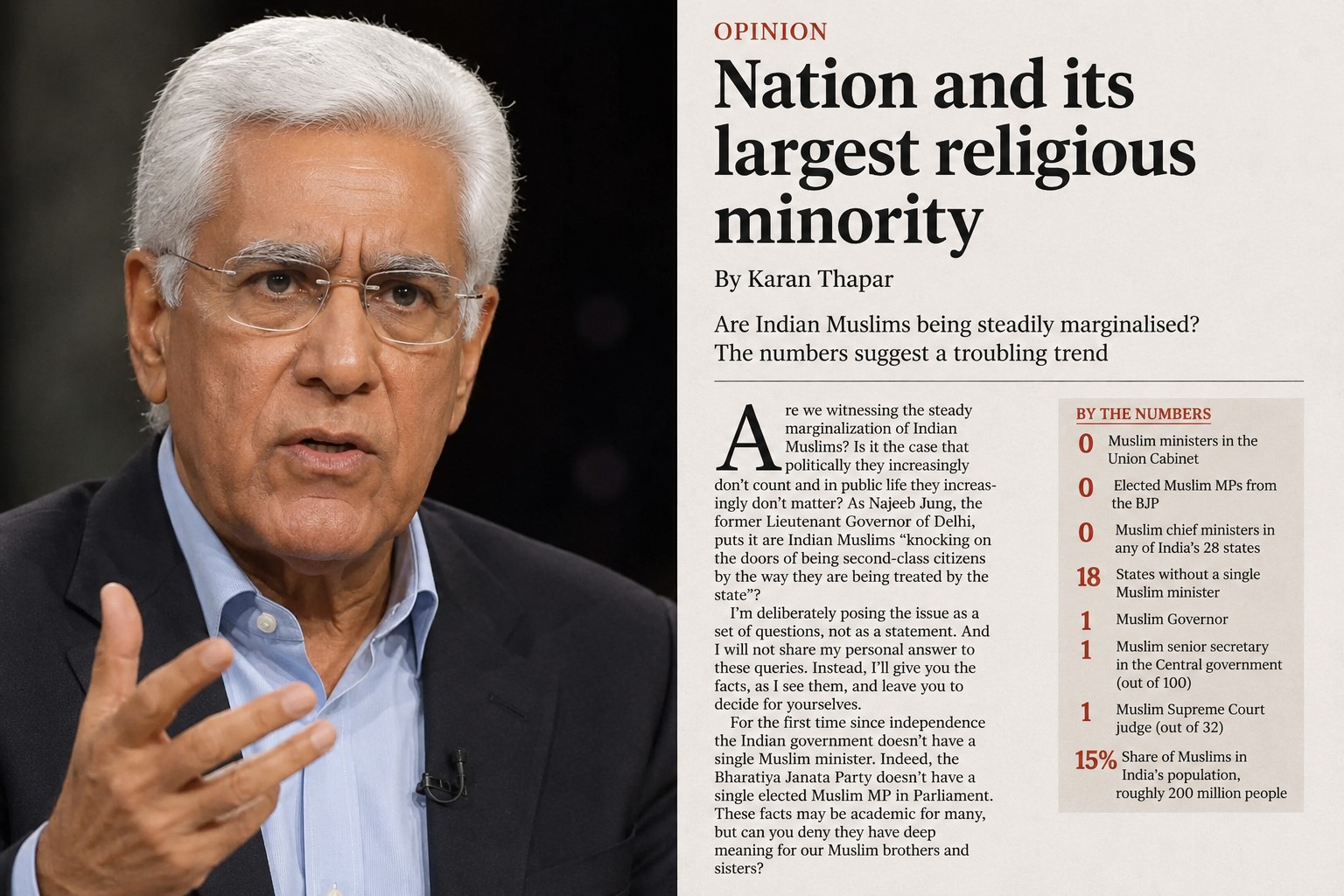
Karan Thapar’s article published in The Hindustan Times, is an eye opener for the Modi led BJP regime in India. It presents a serious and thought-provoking assessment of the plight of the Muslims in India, particularly regarding their political representation, participation in governance, and visibility in public life. He dwells honestly and fairly on statistical and institutional indicators, encouraging readers to reflect on whether Indian Muslims are gradually becoming politically marginalized within the country’s democratic framework.
Thapar notes that, for the first time since independence, the Indian government does not have a single Muslim minister. Additionally, the ruling Bharatiya Janata Party does not have a single elected Muslim Member of Parliament. While these may appear symbolic to some observers, such developments carry deep psychological and political significance for a community that constitutes approximately 15 percent of India’s population, estimated at nearly 200 million people.
The article further highlights electoral patterns that Thapar interprets as evidence of deliberate political exclusion. In West Bengal, where Muslims comprise 27 percent of the population, and in Assam, where Muslims account for 34 percent, the BJP reportedly won substantial mandates without fielding a single Muslim candidate. Thapar argues that this cannot simply be dismissed as electoral coincidence, especially considering similar patterns previously observed in states such as Gujarat, Uttar Pradesh, and Bihar. According to the article, the only Muslims elected in these states largely belong to opposition parties. In Assam, 22 out of 24 opposition winners were Muslim, while in Bengal 34 out of 40 Muslim legislators belonged to the Trinamool Congress.
The broader institutional picture outlined in the article is equally significant. The author points out that none of India’s 28 states currently has a Muslim chief minister, while 18 states do not even have a Muslim minister. He further observes that India presently has only one Muslim governor, one Muslim senior central government secretary out of 100 and one Muslim Supreme Court judge out of 32 judges.
These figures are contrasted with earlier decades in Indian history when Muslims held some of the country’s highest offices, including President, Vice President, Home Minister, External Affairs Minister, heads of armed forces and intelligence agencies
The article suggests that this shift may indicate a shrinking Muslim presence within India’s institutional and political structures.
Another major issue raised in this article concerns the public discourse surrounding Muslims in India. He argues that questions about Muslim representation and marginalization are rarely debated openly within mainstream Indian society or media. According to him, concerns regarding Indian Muslims are increasingly highlighted by international media outlets such as BBC, The Financial Times, The Economist, The New York Times, The Washington Post, Al Jazeera.
Thapar cites comments by former Delhi Lieutenant Governor Najeeb Jung, who described Indian Muslims as:
“A minority in the backyard, a minority that is ill-treated, a minority that doesn’t find a place in the Indian horizon.”
Najeeb Jung further warned that Muslims in India are in a “very grave situation.” These observations reflect a broader concern that many Muslims may increasingly feel politically invisible and socially insecure despite being equal citizens under the Constitution. This can lead to resentment and reaction from the alienated lot.
At the same time, the issue requires careful and balanced examination. India remains a constitutional democracy with an independent judiciary, active media, competitive elections, and legal protections for minorities. Millions of Indian Muslims continue to make major contributions in business, arts, sports, academia, technology, entertainment, and civil society. Therefore, discussions on marginalization should aim to strengthen inclusion and democratic accountability rather than deepen communal polarization.
The core argument emerging from Thapar’s article is that sustainable national development cannot occur if a community of nearly 200 million people feels alienated from political participation and public institutions. Modi led BJP’s bigoted policies are clearly detrimental to the vision of “Viksit Bharat” which ultimately depends on whether all citizens—regardless of religion—feel represented, respected, and included within the national project.
The way forward calls for distinct but complementary efforts from all stakeholders. India would be well served by enhancing political inclusion, with parties encouraging greater minority participation in electoral politics, cabinet appointments, and public institutions, since even symbolic inclusion carries significant social and psychological weight; by consistently reaffirming the constitutional guarantees of equality, religious freedom, and non-discrimination through both policy and political messaging; by improving the representation of minorities across the civil services, judiciary, academia, armed forces, and security institutions; by promoting a balanced public discourse in which media and political leadership discourage communal polarisation and encourage fact-based discussion of minority concerns and social cohesion; and by prioritising socioeconomic empowerment through greater investment in education, healthcare, housing, and employment in underdeveloped Muslim-majority areas to reduce long-standing disparities. Pakistan, for its part, should continue to raise minority-rights concerns through constructive diplomatic engagement and multilateral forums, while recognising that its advocacy will carry far greater legitimacy if it simultaneously strengthens protections for minorities within its own borders, including religious freedom and equal citizenship; it should encourage regional human-rights dialogue by supporting academic institutions, think tanks, and civil-society groups working toward communal harmony and coexistence in South Asia, and it should frame the issue through humanitarian and democratic principles rather than inflammatory rhetoric that risks deepening regional tensions. The international community, finally, should support inclusive democracy by continuing to encourage inclusive governance and equal-citizenship protections worldwide, including in India; promote independent and objective human-rights monitoring free of politicisation; encourage interfaith initiatives and educational programmes that reduce communal mistrust; apply universal human-rights standards consistently rather than selectively; and maintain strategic engagement with India while encouraging continued adherence to democratic norms, pluralism, and the protection of minorities.
The long-term strength of any democracy depends not only on elections and economic growth, but also on whether all communities feel they have an equal stake in the nation’s future. The figures and concerns highlighted in Karan Thapar’s article raise important questions about representation, participation, and inclusion for nearly 200 million Indian Muslims. Addressing these concerns through dialogue, constitutional safeguards, and institutional inclusion is essential not only for Muslims, but also for the credibility, stability, and pluralistic character of Indian democracy itself. The question is would Modi led BJP, perpetually pursuing Hindutva policies, pay heed to the sane advice?
The author is the Chief Editor of The Strategic Brief