
Naveed Elahi
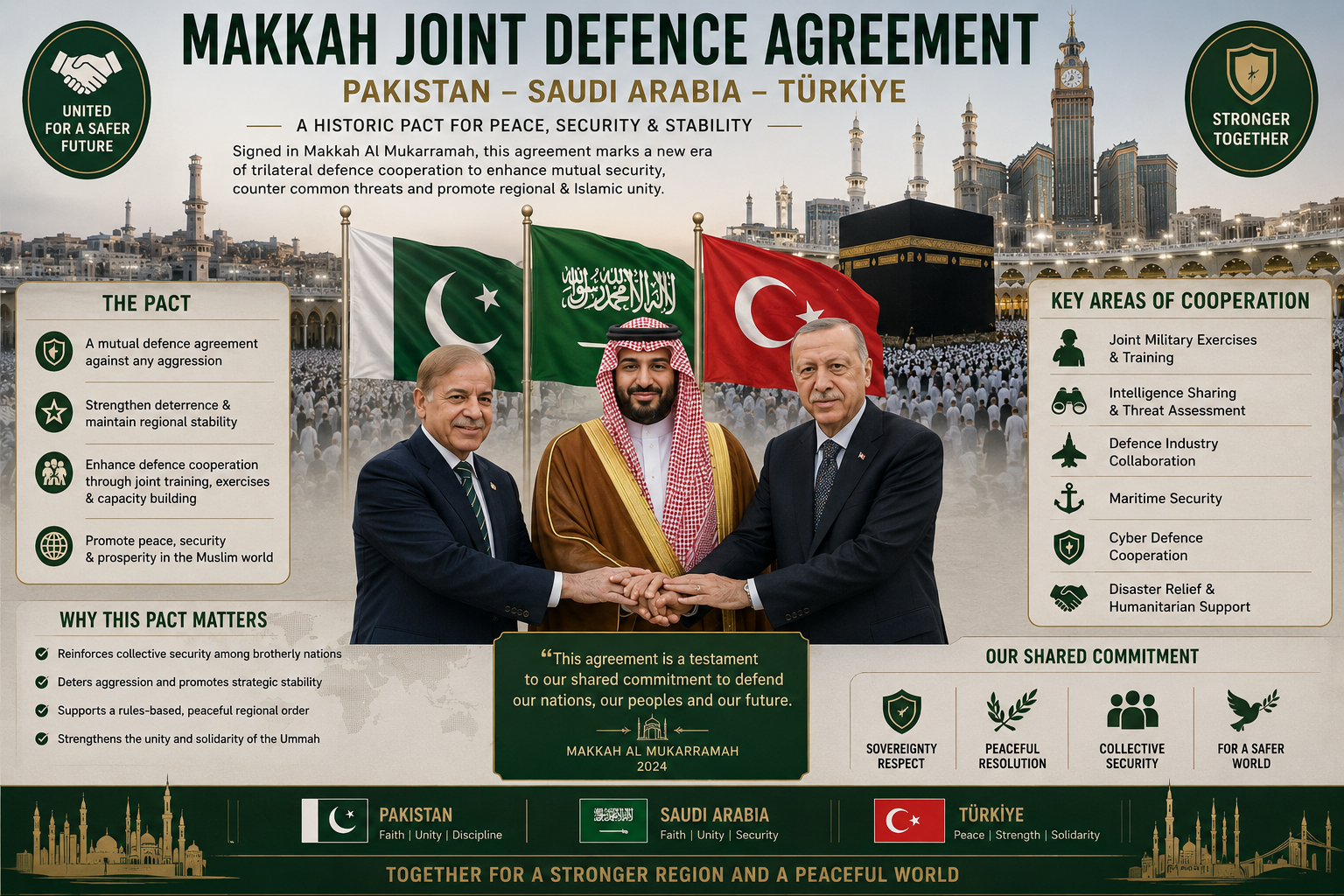
On Friday, 7 August 2026, the leaders of Pakistan, Saudi Arabia, and Turkey signed a trilateral mutual-defence agreement in Islam’s holiest city Makkah, that binds three of the Muslim world’s heaviest strategic actors into a single security compact. Known as the Makkah Joint Defence Agreement (MJDA), the pact commits each state to treat an armed attack on any one of the three as an attack on all — a collective-defence formula deliberately echoing NATO’s Article 5. It was signed by Pakistan’s Prime Minister Shehbaz Sharif, Saudi Crown Prince and Prime Minister Mohammed bin Salman, and Turkish President Recep Tayyip Erdogan and, with Pakistan’s army chief, Field Marshal Syed Asim Munir, in attendance. It was announced by the three countries through a joint statement.
The choice of venue was itself a message. Signing in Makkah underscored a shared Sunni Muslim identity among the three governments and lent the arrangement symbolic weight to match its strategic intent. Beyond the headline mutual-defence clause, the joint statement pledged to deepen cooperation across intelligence-sharing, joint exercises and training, defence-technology collaboration and longer-term strategic coordination. Turkish officials grounded the agreement in Article 51 of the UN Charter, which affirms the right to individual or collective self-defence, and all three governments were at pains to frame the pact as defensive, not offensive — not aimed at any particular country, not superseding existing alliances, and open to other regional states that might wish to join.
A war as catalyst
The timing is inseparable from the conflict raging around it. Since a US–Israeli attack on Iran on 28 February 2026, Iran has struck Saudi Arabia, Kuwait, Bahrain, Qatar, the UAE, Oman, Jordan and Israel, and have disrupted shipping and energy exports through the Strait of Hormuz, the artery for a large share of the world’s oil. Iran-aligned Houthi forces have separately intensified attacks on Saudi-linked targets. Israel has been trying to aggravate the situation by creating doubts among the Gulf states. For Gulf states finding themselves in the line of fire, the appeal of an additional security guarantee is obvious.
Furthermore, the US has over years not been successful to ensure regional stability and security that it had guaranteed to the Gulf countries. Therefore, this trilateral defence pact has emerged as the beginning of an alternate security architecture for this area, which also sees Israel as the potential threat to the West Asia and Middle East regions. Israeli ministers have been openly threatening Turkey as the threat to Israel after Iran.
What makes the three signatories a natural grouping is the complementarity of what each brings. Saudi Arabia supplies financial depth and the custodianship of Makkah and Medina; Pakistan contributes a a large standing army, hard combat experience and nuclear arsenal; Turkey adds NATO membership, the alliance’s second-largest army, and a fast-rising defence-industrial base built around drone production. These ties are not new — Pakistan and Turkey have exchanged warships and training aircraft for years, and in 2023 Saudi Arabia signed what Ankara called its largest-ever defence export deal to buy Turkish drones — but the war accelerated their formalisation.
From a bilateral pact to a near-quadrilateral bloc
The Makkah agreement has not appeared from nowhere. It extends a bilateral Pakistan–Saudi Strategic Mutual Defence Agreement signed in Riyadh on 17 September 2025, days after an Israeli air strike on Hamas leadership in Doha. That earlier pact likewise declared aggression against one to be aggression against both and was widely read as carrying an implicit nuclear dimension, given Saudi Arabia’s reported historical role in financing Pakistan’s weapons programme and years of speculation that the kingdom could shelter under Islamabad’s nuclear umbrella. Both governments have avoided the word “nuclear” while addressing it by implication; Saudi officials have explicitly denied the new pact is linked to any nuclear ambitions.
Turkey’s accession had been anticipated since January 2026, when Ankara signalled interest in joining a NATO-style framework amid its own doubts about the reliability of US commitments under the Trump administration. Running in parallel was a broader diplomatic track that some regional commentators dubbed an emerging “Islamic NATO” or “Green NATO.” Foreign ministers from Pakistan, Turkey, Egypt and Saudi Arabia met four times — in Riyadh, Islamabad, Antalya and Cairo — between March and June 2026, coordinating a response to the Iran war and floating proposals such as replacing Iran’s unilateral control over Hormuz passage with a multilateral, Suez-style consortium.
Yet Egypt, despite attending every round, was absent when the pact was signed. Analysts attribute Cairo’s abstention to a different risk calculus: an overriding focus on economic stability, a long-standing wariness of being pulled into a wider conflict, and a Mediterranean geography that leaves it less directly exposed than the Gulf. Whether Egypt — or Qatar, Syria or the UAE — eventually accedes remains open; some voices, including a former Qatari prime minister, have publicly urged a four-way alliance as an “urgent need.”
Not quite NATO
For all the Article 5 language, specialists caution against overreading the pact as a NATO equivalent. Regional analysts describe it instead as a framework for closer strategic, military and defence-industrial coordination among three influential powers — a pooling of complementary national assets rather than an integrated command structure with standing forces. That distinction matters, because the agreement signed in Makkah is, so far, a political and military declaration: no ratification timeline, joint command, or force-commitment schedule has been made public.
History offers cautionary parallels. The Saudi-led Islamic Military Counter Terrorism Coalition won broad membership but never built a binding command or the ability to project force, and the 1950s Baghdad Pact foundered on weak institutionalisation and competing national interests. Whether the Makkah pact escapes that pattern will depend on whether it develops enforceable mechanisms — and on whether Saudi and Pakistani threat perceptions stay aligned once the immediate pressure of the Iran war eases. Nevertheless, Israel’s lingering threat to Gulf countries, can compel other countries to join it. It might then take the shape of Muslim countries’ NATO.
Reactions and unanswered questions
The response from key capitals has been guarded. Israel declined to comment, as it had after the 2025 bilateral pact, though the symbolism of a nuclear-armed Muslim-majority alliance formalising itself amid Israeli operations across multiple fronts is unlikely to go unnoticed. India said it was “closely following” the development, reflecting New Delhi’s sensitivity to Pakistan’s alliance-building after their May 2025 conflict. Washington, meanwhile, has been negotiating its own defence arrangement with Riyadh; the emergence of a trilateral regional guarantee before any US–Saudi deal is finalised raises the question of whether the Gulf increasingly sees home-grown security as an alternative, or merely a complement, to American protection.
That “fraying umbrella” narrative is real but incomplete. Saudi Arabia has behaved less like a passive client than an autonomous actor during the war — reportedly telling Iran it would not allow its territory to be used against it, conducting covert strikes on Iranian launch sites, and denying the US the use of Saudi bases to reopen Hormuz by force. The kingdom, in other words, was already hedging. The Makkah pact institutionalises that instinct. Its ultimate significance will hinge on whether the three states convert a declaration of solidarity into durable, operational structures — or whether, like earlier attempts, it remains chiefly a signal. The twist can be Iran’s inclusion in this pact.
The author is Chief Editor of The Strategic Brief



The Sub-Contracting Pattern: As Washington seeks to reduce its direct military footprint following escalation and economic strain in West Asia, it relies on key regional partners to manage regional stability.
Pakistan’s Security Export: Islamabad’s participation reflects a historical reliance on providing expeditionary manpower, military training, and security guarantees to the Gulf in exchange for financial assistance and Western backing.
The Trap for Islamabad: If Pakistan is being “cued” by Washington to anchor Gulf stability, it runs the dangerous risk of being drawn into a Middle Eastern quagmire—directly entangling its forces with Iranian-backed networks and risking domestic friction while its primary existential focus remains on its eastern border.